

New versions of the malicious npm package js-logger-pack, including 1.1.27, have shifted exfiltration to Hugging Face. Earlier versions already used the platform as a malware CDN; SafeDep documented that earlier phase. What is new is that the operator now outsources stolen data storage to private Hugging Face datasets rather than hosting it on the C2 server directly. JFrog Security researchers extracted and analyzed the identical embedded JavaScript payload from all four Node SEA binaries, documented the live C2 protocol, and mapped the distribution infrastructure to a cluster of linked public personas. If you installed this package, or any version that pulls the MicrosoftSystem64 binaries, you must assume your environment is compromised. The malware persists on Windows, macOS, and Linux, beacons to a hard-coded controller, logs keystrokes, monitors the clipboard, and exfiltrates stolen data to private Hugging Face datasets controlled by the attacker.
The published package is a bait-and-switch. dist/index.js contains a plausible but benign logger implementation. The actual trigger is the postinstall script in package.json:
"scripts": {
  "postinstall": "node print.cjs"
}
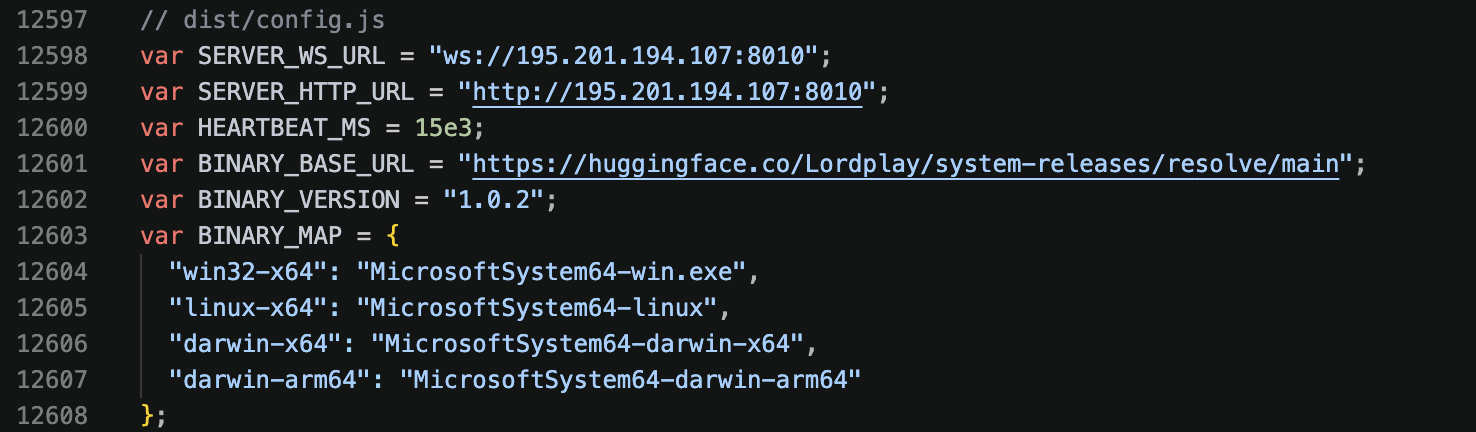
print.cjs backgrounds itself into a detached Node child so npm install terminates while the downloader keeps running. It pulls one of four filenames from https://huggingface.co/Lordplay/system-releases/resolve/main/ based on the host platform and architecture.
What makes this current stage notable is the packaging. The four downloaded binaries are not four different malware families. They are the same cross-platform implant injected into four Node.js Single Executable Application (SEA) containers:
MicrosoftSystem64-win.exe- PE32+ x64MicrosoftSystem64-darwin-x64- Mach-O x64MicrosoftSystem64-darwin-arm64- Mach-O arm64MicrosoftSystem64-linux- ELF x64
We wrote an extraction helper, and pulled the embedded NODE_SEA_BLOB from every sample cleanly. The extracted JavaScript bundle matches the same hash for all distributions:
| Artifact | SHA-256 |
|---|---|
| SEA blob | 46b9522ba2dc757ac00a513dbd98b28babb018eae92347f2cbc3c7a5020872b5 |
| Embedded JS | 1c83019b52be6da9583d28fe934441a74eacef0cd7dbb9d71017122de6fe7cfc |
The wrappers are stock Node v20.18.2 runtimes. The malicious logic lives entirely inside the injected JavaScript bundle. That means the Windows binary contains systemd strings, and the Linux binary contains Windows scheduled-task strings, because the same cross-platform JS ships in every container.

This final payload’s analysis is the core technical addition we are publishing. Prior public reporting by SafeDep documented the campaign family and earlier phases, but the current Hugging Face-hosted second stage had not been extracted and documented at this level of detail.
The SEA entrypoint is simple. It sets the process title to MicrosoftSystem64, registers persistence if not already registered, connects to the controller, and starts collecting data. Baseline automatic behavior includes:
- persisting via scheduled task / Run key (Windows), LaunchAgent (macOS), or systemd user unit / XDG autostart (Linux);
- beaconing system info to the hard-coded controller at
ws[:]//195[.]201[.]194[.]107:8010andhttp[:]//195[.]201[.]194[.]107:8010; - starting clipboard monitoring and a platform-specific keylogger;
- scheduling self-update checks against the same Hugging Face repository;
- resuming any previously failed Hugging Face uploads from local state.
Large-scale file scanning, Telegram exfiltration, browser session clearing, and arbitrary Hugging Face dataset uploads are operator-triggered tasks, not automatic startup behavior.
The implant speaks a typed task protocol over WebSocket. The capability list is explicit in the extracted bundle:
ping,get_system_info,list_drives,list_dirread_text_file,read_file,read_file_chunk,write_file,create_dir,delete_file,delete_dirget_folder_size,get_multi_folder_size,get_multi_item_sizescan_files- recursive credential, wallet, browser, shell-history, and environment-variable scanningsend_tdata- Telegram Desktoptdataexfiltration on Windows and macOSupload_folder_hf- archive arbitrary files/folders and upload them to attacker-supplied private Hugging Face datasetsclear_sessions- kill browser processes and destroy session/credential storesupdate_agent- self-update or restartdeploy_binary- download and persist an arbitrary binary from an arbitrary URL
The filesystem tasks accept absolute paths, UNC paths, ~ expansion, and drive-letter paths with no sandbox or allowlist. The operator can read or write any user-accessible file.
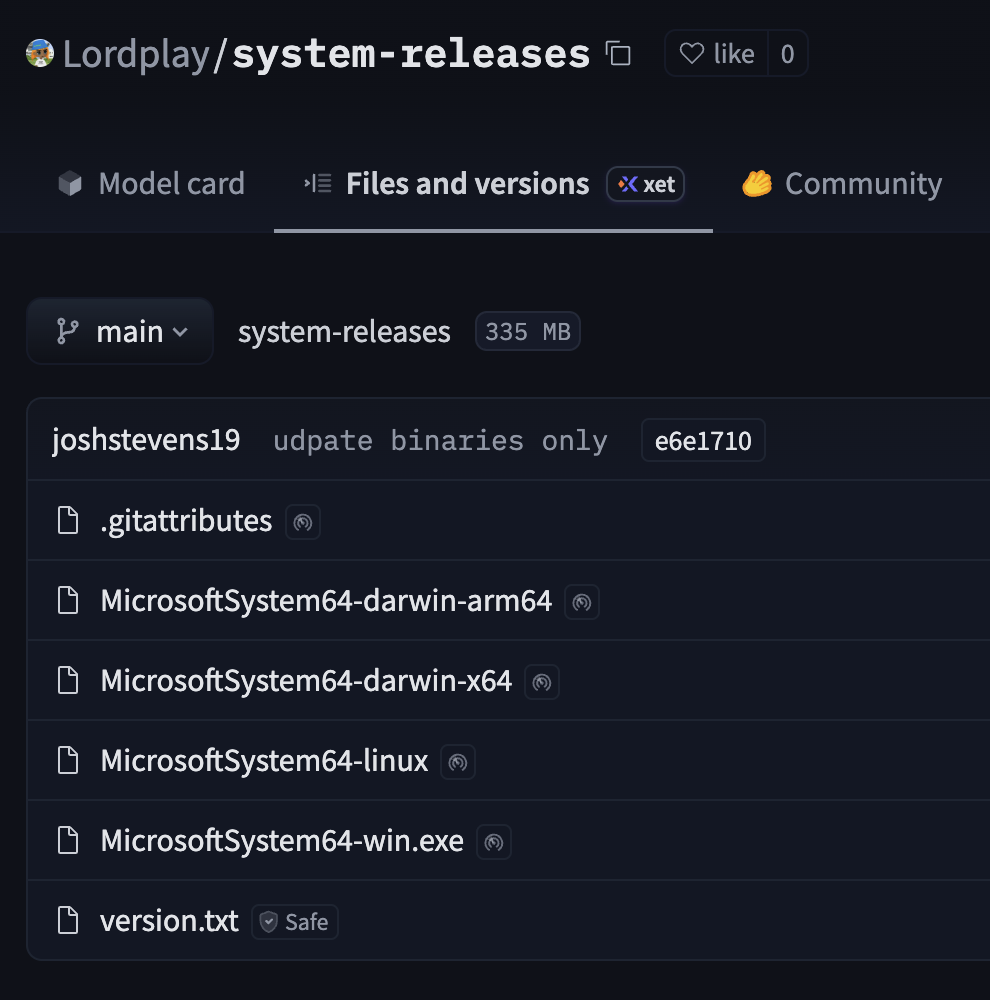
The public Hugging Face repository Lordplay/system-releases is not just a static dump. The package-stage downloader fetches the initial binary from it, and the implanted binary later polls version.txt from the same repo to check for updates. If the version increased, it downloads the replacement binary in place and restarts. There is no signature or checksum validation at any step.
The repository history also matches the extracted code. One commit message reads v1.0.1: rebuild with upload_folder_hf support, which is an observed task in the client, executable via commands from the C2 server.
The most unusual current-stage behavior is the use of Hugging Face itself as a data-theft destination.
When the operator issues an upload_folder_hf task, the implant receives hfToken, hfUsername, a target path, and an uploadId. It then:
- archives the requested file or folder into a gzip file under the system temp directory;
- creates or reuses a private Hugging Face dataset named from the
agentIdand the target path; - uploads the archive into that dataset using the embedded
@huggingface/hubclient; - notifies the Hetzner controller via
/api/validate/hf-upload-completeonce the upload finishes.
Pending uploads are tracked in ~/.pcl-state/uploads.json and resumed on reconnect. This means the live C2 server never has to host the bulk stolen content itself. The operator can point the implant at attacker-controlled or compromised Hugging Face accounts and let Hugging Face's infrastructure handle the storage and transfer.
The implant also supports clear_sessions, which kills browser processes and destroys session stores to force reauthentication while the keylogger is already running. That combination makes the Hugging Face exfiltration channel especially dangerous: credentials typed into a browser after a forced logout can be captured and shipped to a private dataset within minutes.
Because the bundle is cross-platform JavaScript, it reaches into native helper code at runtime:
- Windows: compiles C# in-memory via PowerShell
Add-Typeto install aSetWindowsHookExlow-level keyboard hook, with UIAAutomation-based password-field detection. - macOS: writes a temporary Swift source file to
/tmp/.sys_<pid>.swift, compiles it withswiftc, and runs the resulting binary to capture keys viaCGEvent.tapCreateandAXUIElement. - Linux: attempts X11 capture via
xinput test-xi2, then falls back to reading raw evdev data from/dev/input/event*.
Clipboard collection uses OpenClipboard on Windows, CGEvent on macOS, and xclip / xsel / wl-paste on Linux.
This campaign has already been documented publicly. OSV tracks the package family as MAL-2026-2827, and SafeDep published detailed analysis of earlier versions through the binary-dropper pivot.
Our analysis confirms that the current Hugging Face binaries execute an identical Node sample, documents the current C2 schema/transport logic, and maps the distribution infrastructure to a cluster of linked public identities. Relative to prior public reporting, the main additions here are the analysis of the second-stage implant, and the OSINT tracing of the Hugging Face distribution channel.
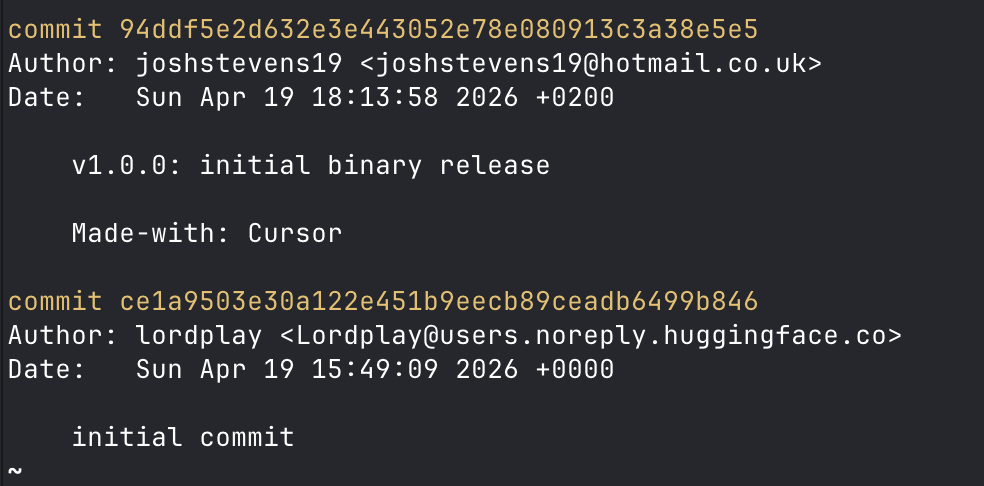
The Lordplay Hugging Face namespace is not a one-day account created for this campaign. Public API metadata shows six older sports and computer-vision model repositories created in February 2026. The malicious Lordplay/system-releases repo appeared later, on 2026-04-19T15:49:09Z.
Older Lordplay repositories show a stable identity pattern: system commits as Lim Hwang <Lordplay@users.noreply.huggingface.co> and direct git pushes as Lordplay <limhwang1228@gmail.com>. The system-releases repository breaks that pattern. The initial creation commit is a normal Hugging Face Lordplay system commit. Later malware-related commits switch to joshstevens19 <joshstevens19@hotmail.co.uk>.
joshstevens19@hotmail.co.uk matches the real identity of Josh Stevens, Engineering VP at Polymarket. There is no public Hugging Face account named joshstevens19. The commit metadata is a git author string, not proof that Stevens pushed the repository. We assess with high confidence that the threat actor is deliberately impersonating a known engineering executive to plant false authorship and muddy attribution.
A second public cluster links the campaign to the whisdev persona set:
- The
LordplayHugging Face profile links towhisdev. - The public
whisdevGitHub profile links directly to a Telegram user namedsnipmaxi. whisdev.orgis brandedLordplayand links to the same Telegram handle.jrodacooker.devalso links tosnipmaxi.- Public
whisdevrepositories include Polymarket-related utilities and trading tools, placing the persona in the Web3 and prediction-market space.
That cluster overlaps earlier campaign infrastructure. We found an earlier C2 at api-sub[.]jrodacooker.dev in js-logger-pack@1.1.5. Telemetry shows the current Hetzner controller IP 195[.]201[.]194[.]107 previously served a TLS certificate for copilot-ai[.]whisdev[.]org. We independently confirmed the certificate existed.
We recovered an attacker's SSH public key with the comment bink@DESKTOP-N8JGD6T referenced in js-logger-pack@1.1.5. Public raw git history for whisdev/ptcbink contains Ptc Bink, ptc-bink, and ptcbink author identities, including GitHub noreply addresses tied to the whisdev account ID 142078464 and the email sakelejames@gmail.com. The bink overlap is notable and worth provider-side investigation, but public data alone is not enough to name an operator.
Public data alone does not prove that Josh Stevens authored the malware, or that the real whisdev operators knowingly ran the campaign, or that any of the linked accounts were definitely compromised. The available evidence points to deliberate impersonation of Stevens, not genuine authorship. What the data does show is:
- The
Lordplaynamespace was used with a sharply different identity than its earlier history. - The
joshstevens19metadata on Hugging Face looks like spoofed or planted git authorship, as to frame Stevens for this supply chain attack. - The
whisdev/snipmaxi/jrodacooker.devcluster is a real, campaign-adjacent persona and infrastructure set. - The
binkalias overlap is worth tracking, but it is not a standalone attribution.
If you installed js-logger-pack@1.1.27, or any version that dropped the MicrosoftSystem64 binaries, you must assume the machine or CI/CD runner is compromised. Take these steps immediately.
The malware can browse, read, and write arbitrary files, scan for secrets, log keystrokes, and deploy additional payloads. Any secrets on the machine are at risk.
- Rotate all secrets accessible in the environment: AWS keys, npm tokens, SSH keys, database passwords, API keys, wallet seeds, and any credentials stored in browser profiles.
- Audit registry and source-control logs for unauthorized access or pushes.
Windows:
- Delete the scheduled task:
\MicrosoftSystem64 - Delete the registry fallback:
HKCU\Software\Microsoft\Windows\CurrentVersion\Run\MicrosoftSystem64 - Delete
%LOCALAPPDATA%\MicrosoftSystem64.exe - Delete
%LOCALAPPDATA%\MicrosoftSystem64.vbs - Delete
%LOCALAPPDATA%\.registered
macOS:
- Unload and delete the LaunchAgent:
launchctl bootout gui/$(id -u) ~/Library/LaunchAgents/com.launchkeeper.MicrosoftSystem64.plist
rm -f ~/Library/LaunchAgents/com.launchkeeper.MicrosoftSystem64.plist
- Delete
~/Library/Application Support/MicrosoftSystem64 - Delete
~/Library/Application Support/.registered
Linux:
- Stop and disable the systemd user unit:
systemctl --user stop MicrosoftSystem64.service
systemctl --user disable MicrosoftSystem64.service
- Delete
~/.config/systemd/user/MicrosoftSystem64.service - Delete
~/.config/autostart/MicrosoftSystem64.desktop - Delete
~/.local/share/MicrosoftSystem64 - Delete
~/.local/share/.registered
Remove the data directories and upload state the implant created:
Windows:
rmdir /s /q "%LOCALAPPDATA%\.pcl-data"
rmdir /s /q "%USERPROFILE%\.pcl-state"
macOS / Linux:
rm -rf ~/.pcl-data
rm -rf ~/.pcl-state
rm -f /tmp/.sys_*.swift
rm -f /tmp/.sys_*_bin
Purge the package and lockfiles:
rm -rf node_modules package-lock.json
npm cache clean --force
Review package.json for any reference to js-logger-pack and remove it before reinstalling dependencies.
- Run
npm config set ignore-scripts trueto preventpostinstallhooks from executing automatically. - Review
package.jsonchanges in dependency updates, even for patch releases. - Implement automated dependency scanning and approval workflows with JFrog Curation to ensure only vetted packages enter your supply chain.
| Package Name | Malicious Versions | Xray ID |
|---|---|---|
js-logger-pack (npm) |
1.1.0 up to 1.1.27 | XRAY-965126 |
Lordplay/system-releases (Hugging Face) |
1.1.27 | XRAY-968550 |
js-logger-pack@1.1.27 is a thin but effective supply-chain dropper, creatively abusing Hugging Face as a CDN and an exfiltration backend. The npm package itself does little more than fetch a platform binary from a public Hugging Face repository, yet the resulting implant is a full operator foothold with cross-platform persistence, live keylogging, arbitrary file access, and secondary payload deployment.
Our research adds three things to the public record. First, we analyzed the binaries hosted on Hugging Face, and documented the C2 protocol. Second, we identified that the operator is actively using Hugging Face private datasets as a live exfiltration backend, outsourcing stolen data storage to Hugging Face infrastructure rather than hosting it on the C2 server directly. Third, we traced the distribution infrastructure to a cluster of linked public personas and mapped the sharp identity break inside the Lordplay namespace, the impersonation of Polymarket VP Josh Stevens, and the campaign-adjacent whisdev / snipmaxi / jrodacooker.dev cluster.
Because the entire chain relies on unverified downloads and plaintext controller traffic, the safest remediation is to treat any affected host as fully compromised, rotate all secrets, and remove persistence artifacts across Windows, macOS, and Linux.
JFrog Xray and JFrog Curation provide detection for this malicious package family.
js-logger-pack-1.1.27
ws[:]//195[.]201[.]194[.]107:8010http[:]//195[.]201[.]194[.]107:8010https[:]//huggingface[.]co/Lordplay/system-releases/resolve/main/MicrosoftSystem64-win.exehttps[:]//huggingface[.]co/Lordplay/system-releases/resolve/main/MicrosoftSystem64-darwin-x64https[:]//huggingface[.]co/Lordplay/system-releases/resolve/main/MicrosoftSystem64-darwin-arm64https[:]//huggingface[.]co/Lordplay/system-releases/resolve/main/MicrosoftSystem64-linuxhttps[:]//huggingface[.]co/Lordplay/system-releases/resolve/main/version.txt
| Name | SHA-256 |
|---|---|
MicrosoftSystem64-win.exe |
f2c754a7f7b56e0e2a6dd429f06c42a1860c52c37b25d0a8e91c67d1239fa577 |
MicrosoftSystem64-darwin-x64 |
457a3323fe0cfa82d6e102074c6f07a399f55c7e0ce2d3b40643d9cfde0cf220 |
MicrosoftSystem64-darwin-arm64 |
2fec04f2985510654d9656d57f6817de1ca0d6ae49e7085b1e33abb38f89cc55 |
MicrosoftSystem64-linux |
b505f1d1ca3dca8cb7e2b2dd99991b5a929ec9387f3de31ad36549823af07dfd |
print.cjs |
33401580619ae79bf3f87aab16208f169a44a038f18671b1def7836fb2682c9a (as of js-logger-pack@1.1.27) |
- Windows scheduled task:
\MicrosoftSystem64 - Windows Run key:
HKCU\Software\Microsoft\Windows\CurrentVersion\Run\MicrosoftSystem64 - macOS LaunchAgent:
com.launchkeeper.MicrosoftSystem64 - Linux systemd user unit:
MicrosoftSystem64.service - Linux XDG autostart:
~/.config/autostart/MicrosoftSystem64.desktop
- Process title:
MicrosoftSystem64 %LOCALAPPDATA%\MicrosoftSystem64.exe%LOCALAPPDATA%\MicrosoftSystem64.vbs%LOCALAPPDATA%\.registered%LOCALAPPDATA%\.pcl-data\offline-queue.jsonl%USERPROFILE%\.pcl-state\uploads.json~/Library/Application Support/MicrosoftSystem64~/Library/Application Support/.registered~/Library/Application Support/data/MicrosoftSystem64.log~/Library/Application Support/data/MicrosoftSystem64_err.log~/.local/share/MicrosoftSystem64~/.local/share/.registered~/.pcl-data/offline-queue.jsonl~/.pcl-state/uploads.json/tmp/.sys_<pid>.swift/tmp/.sys_<pid>_bin