

 The JFrog Security Research team is tracking a newly disclosed OpenSSL vulnerability, CVE-2025-15467, a stack overflow issue that may lead to remote code execution (RCE). While no official CVSS score has been assigned yet, it was rated with a “high” severity by OpenSSL and based on its characteristics, we assess that it may be rated as Critical by NVD.
OpenSSL recently patched 12 vulnerabilities, including 10 low, 1 moderate, and 1 high severity issue, but this stack overflow stands out due to its potential impact. An attacker can exploit the stack buffer overflow by sending a crafted CMS AuthEnvelopedData message with maliciously constructed AEAD parameters.
The following OpenSSL versions are vulnerable:
3.6, 3.5, 3.4, 3.3, 3.0
Versions 1.1.1 and 1.0.2 are not affected.
FIPS modules in 3.6, 3.5, 3.4, 3.3, and 3.0 are not affected, as the CMS implementation is outside the FIPS module boundary.
Our research team has managed to reproduce the vulnerability by calling the CMS_Decrypt API directly -
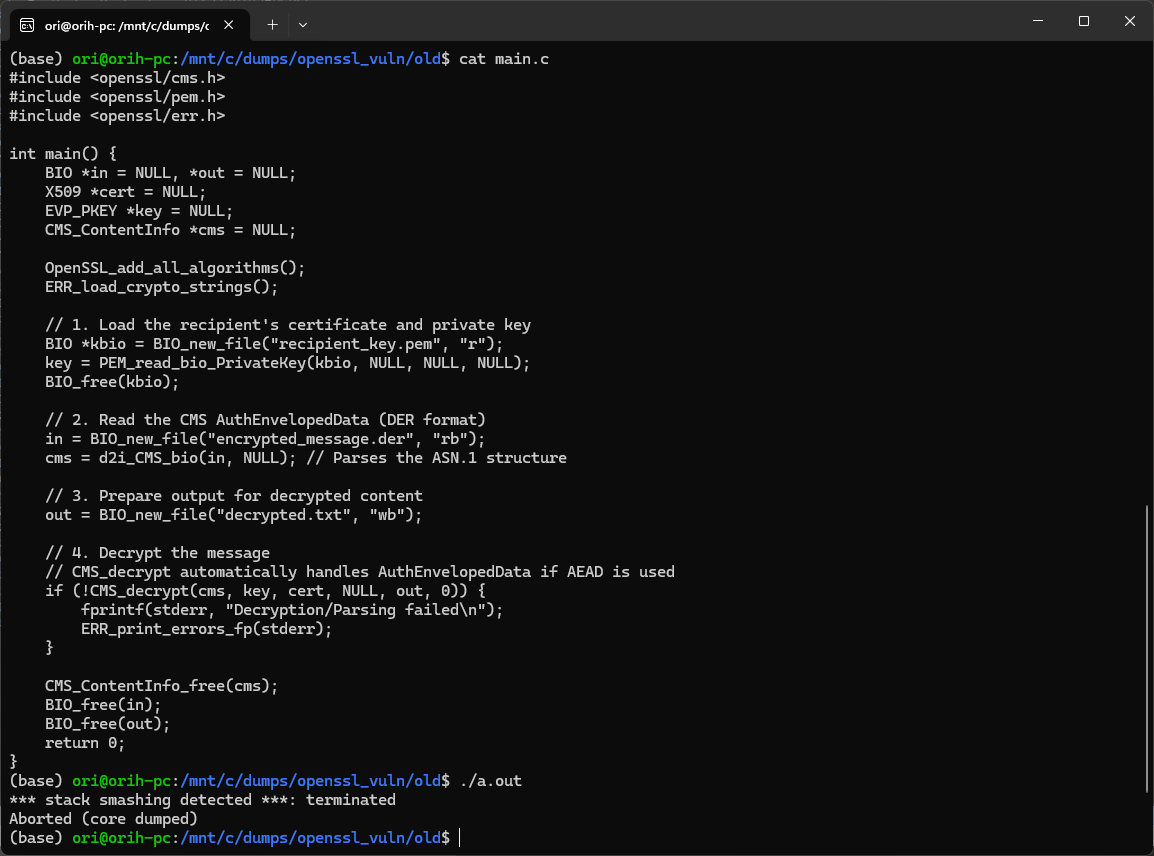
We have observed the following cases to be vulnerable to CVE-2025-15467 -
A. OpenSSL-based applications that call any of the following APIs -
CMS_RecipientInfo_decryptCMS_decrypt_set1_pkey_and_peerCMS_decrypt_set1_pkeyCMS_decryptPKCS7_decryptEVP_CIPHER_asn1_to_paramCMS_EnvelopedData_decrypt
B. Applications that invoke any of the following OpenSSL tools -
openssl cmsopenssl smime
Note that this is only an initial assessment and more attack vectors are likely to be relevant, stay tuned as we update this blog.
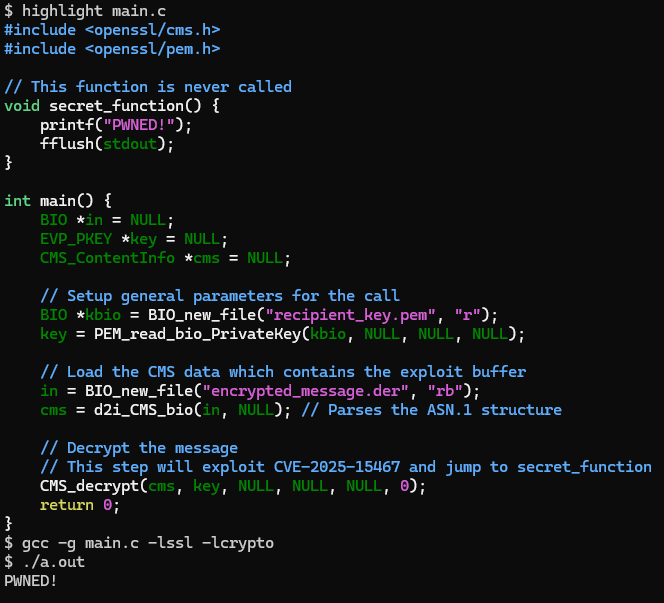
Our research team has successfully achieved code execution by exploiting the CVE. As always - real-world scenarios may require the attacker to bypass exploit mitigations such as Stack Canaries, ASLR and DEP - probably by exploiting a separate infoleak vulnerability.
Affected users should upgrade as follows:
- 3.6 → 3.6.1
- 3.5 → 3.5.5
- 3.4 → 3.4.4
- 3.3 → 3.3.6
- 3.0 → 3.0.19
CMS (Cryptographic Message Syntax) is a standard for securely transmitting messages that ensures confidentiality, integrity, and authenticity. It is widely used in applications such as S/MIME for secure email communication, as well as in file storage and other scenarios where data protection is essential.
AuthEnvelopedData is a specific CMS structure designed to provide both encryption and authentication. Its key features include:
- Confidentiality: The content of the message is encrypted, so only the intended recipients, who possess the appropriate keys, can decrypt and read it.
- Integrity and Authentication: AuthEnvelopedData includes mechanisms to ensure that the message has not been altered in transit. This is typically achieved through a message authentication code (MAC) or an authentication tag, confirming that the data is intact and authentic.
A typical CMS AuthEnvelopedData message in OpenSSL contains:
- Encrypted Content: The actual data or message that needs to be protected through encryption.
- Recipient Information: Details about the intended recipients, usually including cryptographic keys or certificates that allow them to decrypt the message.
- AEAD Cipher Parameters: The message may use authenticated encryption with additional data (AEAD) methods, such as AES-GCM, which provide both encryption and integrity protection in a unified process.
- Initialization Vector (IV): A random value that is essential for many encryption algorithms, ensuring that each encryption operation produces unique ciphertexts, even for identical plaintexts.
When OpenSSL parses a CMS AuthEnvelopedData structure using AEAD ciphers, it extracts the IV (encoded in ASN.1 parameters) to prepare for decryption and authenticity verification.
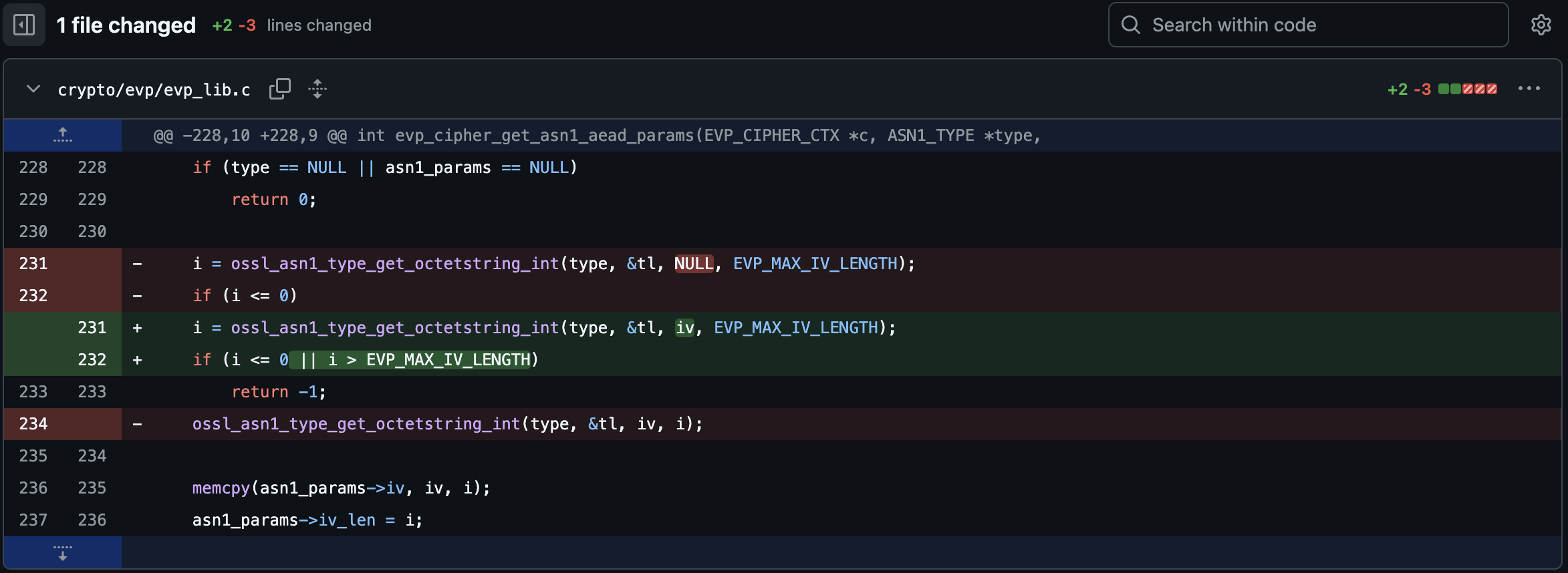
The vulnerability occurs because the IV in the CMS AuthEnvelopedData structure can be oversized. OpenSSL copies the IV into a fixed-size stack buffer without verifying the length, causing a stack overflow that can lead to crashes or potentially RCE.
Importantly, the overflow occurs before any authentication, meaning an attacker does not need valid encryption keys. They only need to craft a malicious CMS message with an oversized IV to trigger the overflow.
This makes applications and services that parse untrusted CMS or PKCS#7 content with AEAD ciphers (e.g., S/MIME AuthEnvelopedData using AES-GCM) vulnerable. Exploitability for RCE depends on platform and toolchain mitigations, but the stack-based write primitive itself represents a significant risk.
From the vulnerability’s fix commit, it is clear that OpenSSL did not check whether the IV size exceeds the fixed-size stack buffer (EVP_MAX_IV_LENGTH) when copying it.
This stack overflow occurs before authentication, making it exploitable in scenarios where untrusted CMS messages are processed. While no official CVSS score has been released yet, the vulnerability is expected to be rated at least as a “high” severity issue by NVD, and potentially even a “Critical” severity issue, given the risk of RCE.
Organizations using affected OpenSSL versions should patch immediately and review systems that process S/MIME or PKCS#7 content to mitigate potential exploitation.
The JFrog Security Research team will continue to monitor this vulnerability for further updates and potential exploitation. Affected versions are already flagged in the JFrog Xray and JFrog Catalog databases, helping our customers identify and mitigate risk quickly.